Introduction
Modern IT environments are no longer simple or static. With the widespread adoption of cloud computing, microservices architecture, Kubernetes clusters, and hybrid infrastructure models, organizations now manage highly distributed and complex systems. As these environments scale, traditional IT operations struggle to handle the growing volume of alerts, incidents, logs, and performance data.
This is where AIOps (Artificial Intelligence for IT Operations) becomes a transformative approach. AIOps uses artificial intelligence and machine learning to enhance IT operations by automating monitoring, detecting anomalies, correlating events, and accelerating root cause analysis. It enables IT teams to move from reactive troubleshooting to proactive and predictive operations, significantly improving system reliability and operational efficiency.
An AIOps certification helps professionals develop the skills needed to operate in modern, automation-driven IT environments. It prepares individuals to work with intelligent monitoring systems, improve incident response, and contribute to large-scale digital transformation initiatives while reducing operational costs and downtime.
What is AIOps and How It Works in Modern IT
AIOps combines artificial intelligence, machine learning, and advanced analytics with IT operations processes to improve visibility, speed, and automation across infrastructure and applications.
In enterprise environments, AIOps platforms typically:
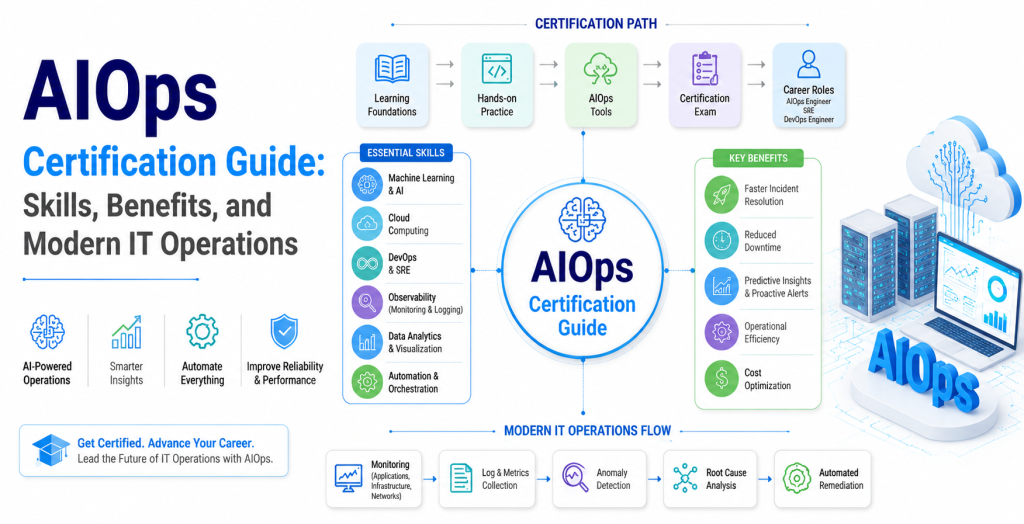
- Collect data from logs, metrics, traces, and event streams
- Identify anomalies in real time using AI models
- Correlate related alerts into meaningful incidents
- Determine probable root causes automatically
- Trigger automated responses or remediation workflows
This approach transforms traditional IT operations from reactive problem-solving into intelligent, proactive system management that improves performance and reduces downtime.
Why AIOps is Becoming Essential for Organizations
Organizations are increasingly adopting AIOps because IT environments are becoming more complex and data-heavy.
Key reasons include:
- Rapid growth of cloud-native applications
- Increasing number of monitoring signals and alerts
- Frequent performance issues in distributed systems
- Need for faster incident detection and resolution
- Pressure to optimize operational spending
Without AIOps, IT teams often face overwhelming alert noise, delayed troubleshooting, and difficulty identifying the actual source of system failures.
Key Challenges in Traditional IT Operations
Even with advanced monitoring tools, many organizations still face operational inefficiencies such as:
- Excessive alert noise leading to alert fatigue
- Slow identification of root causes during incidents
- Limited end-to-end visibility across systems
- Heavy dependence on manual troubleshooting
- High mean time to resolution (MTTR)
- Fragmented incident management processes
These challenges not only increase costs but also reduce overall system reliability and customer satisfaction.
How AIOps Reduces Operational Costs
AIOps helps organizations significantly reduce IT operational expenses by improving efficiency and minimizing manual work.
It achieves this through:
- Automating repetitive operational tasks
- Reducing manual intervention in incident handling
- Preventing outages using predictive analytics
- Optimizing resource usage across infrastructure
- Improving workload distribution and system efficiency
By reducing downtime and improving system stability, organizations achieve better ROI on IT investments.
How AIOps Improves Incident Detection and Resolution
AIOps enhances the entire incident management lifecycle through intelligent automation.
Anomaly Detection
Detects unusual patterns in system behavior before failures occur.
Event Correlation
Groups related alerts together to form meaningful incidents.
Root Cause Analysis
Uses dependency mapping and intelligence models to quickly identify failure sources.
Predictive Insights
Forecasts potential system issues before they impact users.
Automated Remediation
Executes predefined responses to resolve common incidents automatically.
These capabilities help IT teams reduce downtime and respond to incidents much faster.
Benefits of AIOps Certification for Professionals
An AIOps certification helps professionals stay relevant in modern IT environments by building advanced operational skills.
Key benefits include:
- Strong understanding of AI-driven IT operations
- Hands-on experience with observability tools and automation
- Improved incident response and troubleshooting skills
- Better career opportunities in DevOps, SRE, and cloud engineering
- Exposure to enterprise-scale IT environments
- Knowledge of modern monitoring and analytics systems
Certified professionals are increasingly in demand as organizations adopt AI-driven operations.
Benefits of AIOps for Organizations
Organizations that invest in AIOps-certified teams experience significant operational improvements:
- Faster detection and resolution of incidents
- Reduced system downtime and service disruptions
- Increased productivity of IT operations teams
- Standardized and efficient workflows
- Better scalability in cloud environments
- Improved digital transformation outcomes
AIOps helps enterprises achieve more stable and resilient IT ecosystems.
Core Skills Developed Through AIOps Training
AIOps training builds a strong foundation of modern IT operational skills, including:
Event Correlation
Combining multiple system signals into a unified incident view.
Anomaly Detection
Using AI models to identify abnormal system behavior.
Predictive Analytics
Forecasting potential failures before they occur.
Root Cause Analysis
Identifying underlying infrastructure or application issues.
Observability
Improving visibility across distributed systems and microservices.
Incident Management
Efficient handling and resolution of IT incidents.
Automation
Reducing manual effort through intelligent workflows.
Machine Learning for IT Operations
Applying ML techniques to operational data for better insights.
Who Should Pursue AIOps Certification
AIOps certification is suitable for a wide range of IT professionals, including:
- DevOps Engineers
- Site Reliability Engineers (SREs)
- Cloud Engineers
- Platform Engineers
- System Administrators
- IT Operations Teams
- Security Engineers
- IT Managers and Technical Leads
These roles directly benefit from improved automation, observability, and operational intelligence.
AIOps vs Traditional IT Operations
| Aspect | Traditional IT Operations | AIOps-Based Operations |
|---|---|---|
| Monitoring | Manual or rule-based | AI-driven intelligent monitoring |
| Incident Detection | Reactive | Real-time anomaly detection |
| Root Cause Analysis | Manual investigation | Automated dependency analysis |
| Automation | Limited | High level of automation |
| Scalability | Restricted | Highly scalable |
| Operational Cost | Higher | Lower due to automation |
| Response Time | Slower | Faster and predictive |
| Reliability | Lower | Higher system reliability |
AIOps in Digital Transformation
AIOps plays a critical role in enabling digital transformation initiatives by modernizing IT operations.
It supports:
- Cloud-native architecture management
- Kubernetes and microservices monitoring
- DevOps and DevSecOps integration
- Real-time system observability
- Automated IT workflows
This helps enterprises become more agile, scalable, and efficient in their digital journey.
Importance of Continuous Learning in AIOps
IT environments evolve rapidly, making continuous learning essential for professionals.
Key reasons include:
- Continuous emergence of new cloud technologies
- Increasing system complexity
- Rising cybersecurity threats
- Rapid advancements in AI and automation
- Need for updated operational skills
AIOps certification ensures professionals remain competitive in the evolving IT landscape.
How AIOps Training Supports Career Growth
AIOps training is designed to align with real-world IT operations and industry requirements.
It offers:
- Structured learning paths for beginners and professionals
- Practical labs and real-world scenarios
- Exposure to enterprise-grade tools and systems
- Guidance from industry experts
- Career support for DevOps, SRE, and cloud roles
- Flexible learning options for working professionals
This makes it easier to transition into advanced IT operations roles.
Future of AIOps and Intelligent IT Operations
The future of IT operations is increasingly autonomous and AI-driven.
Emerging trends include:
- Self-healing infrastructure systems
- Fully automated incident management
- Advanced observability platforms
- Deep DevSecOps integration
- Autonomous cloud operations
AIOps will continue to be a foundational technology in modern IT ecosystems.
FAQs
1. What is AIOps certification?
It validates knowledge of AI-driven IT operations, including monitoring, automation, and incident management practices used in modern infrastructure environments.
2. Who should learn AIOps?
It is ideal for DevOps engineers, SREs, cloud professionals, and IT operations teams working in complex system environments.
3. Does AIOps help DevOps professionals?
Yes, it enhances automation, improves monitoring, and accelerates incident resolution within DevOps workflows.
4. How does AIOps reduce costs?
It minimizes manual effort, reduces downtime, and improves infrastructure efficiency through intelligent automation.
5. What skills are required for AIOps?
Basic understanding of IT systems, cloud computing, and monitoring tools is helpful for learning AIOps.
6. How is AIOps different from DevOps?
DevOps focuses on software delivery, while AIOps focuses on intelligent and automated IT operations.
7. Do I need programming knowledge?
Basic scripting skills are helpful but not mandatory for most AIOps learning paths.
8. Where is AIOps used?
It is widely used in IT services, banking, telecom, healthcare, and large-scale digital enterprises.
9. How long does certification take?
Depending on the program, it can take a few weeks to a few months to complete.
10. Why choose AIOps training programs?
Because they provide structured, practical, and industry-relevant skills for modern IT operations roles.
Conclusion
AIOps certification has become a key enabler for modern IT professionals aiming to stay relevant in highly automated and cloud-driven environments. It equips learners with essential skills in observability, automation, predictive analytics, and intelligent incident management, all of which are critical for managing today’s complex infrastructures.
For organizations, adopting AIOps leads to faster incident resolution, reduced operational costs, and improved system reliability. It strengthens overall IT efficiency and supports large-scale digital transformation initiatives.
