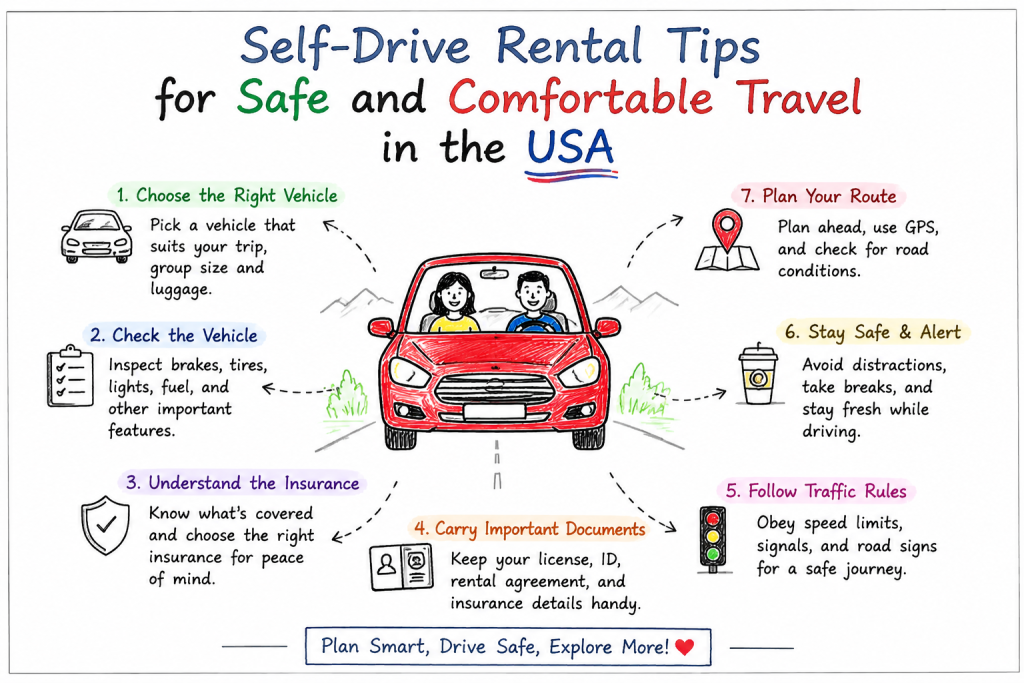
Introduction
Self-drive rentals give travelers the freedom to explore a destination according to their own schedule. Instead of depending on fixed public transport routes, expensive taxi rides, or organized tour schedules, you can choose where to go, when to stop, and how long to stay.
In the United States, self-drive travel is particularly useful because cities, suburbs, national parks, coastal roads, and countryside destinations are often spread across large distances. A rented car, scooter, motorcycle, or other suitable vehicle can make these journeys more convenient and personal.
For Indian travelers accustomed to navigating cities such as Delhi, Mumbai, Bangalore, Pune, Hyderabad, Chennai, Jaipur, Goa, or Kolkata, traveling independently in the United States may feel familiar in some ways but very different in others. Traffic moves on the right side of the road, speed limits are generally higher, road signs follow American standards, and rental conditions can vary between states and providers.
This guide explains how to choose the right rental vehicle, understand documentation requirements, check costs, avoid common mistakes, and travel safely. It is designed for tourists, students, working professionals, backpackers, business travelers, daily commuters, and anyone using a self-drive rental for the first time.
Why Renting a Bike or Self-Drive Vehicle Is a Smart Choice
The United States has an extensive transportation network, but public transportation is not equally available everywhere. Cities such as New York, Chicago, Boston, San Francisco, and Washington, D.C. have useful transit systems, while many suburbs, rural areas, highway destinations, and national parks are easier to reach with a private vehicle.
A self-drive rental can be a smart choice for several reasons.
Greater Freedom
You are not limited by bus schedules, train routes, or taxi availability. You can start early, take breaks, change your route, or visit smaller attractions that organized tours may not cover.
Easier Regional Exploration
A rental vehicle is helpful for exploring areas outside major city centers. Examples include scenic coastal routes, mountain towns, state parks, lakes, beaches, countryside roads, and suburban attractions.
Better Control Over Travel Costs
Daily rental prices can sometimes be more economical than taking several taxi or ride-hailing trips. Sharing a rental car with friends or family may reduce the per-person cost further.
Motorcycles and scooters may also be practical for individual travelers taking shorter journeys, provided the rider has the appropriate license, experience, and protective equipment.
More Personal Travel Experiences
Traveling independently allows you to discover local restaurants, viewpoints, neighborhoods, roadside attractions, and lesser-known destinations. This is similar to how travelers use a bike rental in India to explore areas around Goa, Jaipur, Bangalore, Pune, or Hyderabad beyond conventional tourist routes.
Convenient Luggage Transportation
Cars and larger self-drive vehicles provide useful storage space for suitcases, shopping bags, work equipment, or camping supplies. Motorcycles may be better for light travelers who can pack safely in approved luggage systems.
Who Should Rent a Self-Drive Vehicle?
Self-drive rentals are suitable for many types of travelers.
First-Time Tourists
Tourists who want to explore attractions outside central city areas can benefit from a rental vehicle. It provides more control over the itinerary and reduces dependence on unfamiliar public transportation systems.
International Visitors
International visitors, including travelers from India, can use self-drive rentals for road trips, family visits, business journeys, and regional travel. They must confirm licensing, age, insurance, and identification requirements before booking.
Students
Students may rent economical cars or scooters for short-term transportation, moving between accommodations, attending events, or exploring nearby destinations. Age restrictions and young-driver charges may apply.
Working Professionals
Professionals can use rental vehicles for airport transfers, client visits, conferences, temporary work assignments, or daily commuting during business travel.
Backpackers and Budget Travelers
Budget travelers may choose fuel-efficient cars, commuter motorcycles, or scooters where legally permitted. Comparing rental charges, fuel costs, insurance, parking, and deposit requirements is important before deciding.
Couples, Families, and Groups
Cars, SUVs, and vans are often more suitable for families and groups because they offer passenger comfort, luggage capacity, weather protection, and highway stability.
Motorcycle Enthusiasts
Experienced riders may choose a motorcycle rental to explore scenic routes. They should select a vehicle that matches their riding ability and ensure that their license is accepted in the state where they will travel.
Benefits of Renting a Vehicle for First-Time Travelers
A self-drive vehicle can make a first trip more flexible, but the benefits depend on choosing the correct vehicle and understanding local driving practices.
Flexible Scheduling
You can leave your accommodation when convenient rather than planning the entire day around public transportation.
Door-to-Door Convenience
A rental vehicle allows you to travel directly between hotels, attractions, shopping areas, meeting locations, and airports. This can be especially helpful when traveling with luggage.
Access to More Destinations
Many scenic destinations in the United States are difficult to reach without a private vehicle. Self-drive transportation opens access to national parks, mountain routes, rural towns, coastal communities, and roadside attractions.
Privacy and Personal Space
Travelers can enjoy private space without sharing crowded buses or trains. Families can carry essential items, choose their own music, and take breaks whenever required.
Practical Learning Experience
A properly planned rental journey helps first-time visitors understand American roads, parking systems, fuel stations, rest areas, and highway travel. Starting with a short local journey can build confidence before attempting a long road trip.
Types of Vehicles You Can Rent
Rental availability depends on the city, state, season, owner, and platform. Travelers should select a vehicle according to route, distance, weather, passenger count, luggage, and driving experience.
Scooters
Scooters are generally lightweight, easy to handle, and suitable for short urban trips. They can be convenient in areas with moderate traffic and suitable parking.
However, scooters may not be appropriate for high-speed highways, long-distance travel, heavy luggage, extreme weather, or unfamiliar road conditions. Licensing rules may depend on the scooter’s engine capacity and the state.
Commuter Motorcycles
Commuter motorcycles provide better performance than small scooters while remaining relatively manageable and fuel-efficient. They may suit experienced riders traveling between nearby towns or exploring urban and suburban areas.
Travelers searching for a bike on rent in India often choose commuter bikes for affordability. A similar principle applies in the United States, although vehicle categories, engine sizes, licensing requirements, and road speeds may differ.
Sports Bikes
Sports motorcycles offer strong acceleration, responsive handling, and performance-focused riding positions. They are generally better suited to experienced riders.
First-time renters should not choose a sports bike simply because it looks attractive. The rider must be comfortable with its weight, power, braking response, and seating posture.
Adventure Bikes
Adventure motorcycles are designed for longer distances, varied road conditions, upright seating, and luggage-carrying systems. They can be useful for touring, mountain routes, and multi-day journeys.
Their height and weight may make them difficult for inexperienced or shorter riders. A test of basic handling, balance, and parking confidence is advisable before starting the trip.
Cruiser Motorcycles
Cruisers generally provide a relaxed seating position and are popular for scenic highway journeys. They can be comfortable over long distances but may be heavy at low speeds.
Riders should be confident while making slow turns, parking, reversing manually, and controlling the motorcycle on sloping surfaces.
Electric Bikes and Electric Scooters
Electric two-wheelers can be useful for short-distance city travel. They produce less noise and may have lower running costs.
Before renting, check the expected range, charging method, charging locations, battery level, speed restrictions, and rules regarding where the vehicle can be operated.
Cars, SUVs, and Vans
Cars are the most practical self-drive option for many American journeys. Compact cars are suitable for individuals and couples, while sedans provide additional comfort. SUVs may offer more luggage space and better suitability for certain weather conditions.
Passenger vans and larger vehicles can help groups travel together, but they may cost more to rent, fuel, park, and insure.
How to Choose the Right Vehicle for Your Trip
Choosing the right rental vehicle is more important than selecting the most powerful or stylish option.
Consider the Travel Distance
A scooter may work for short local journeys, while a car, cruiser, touring motorcycle, or adventure motorcycle may be more comfortable for longer routes.
Review the Road Type
Determine whether your route includes city streets, interstate highways, mountain roads, desert areas, coastal routes, or rural roads. Confirm that the vehicle is legally and mechanically suitable for those conditions.
Check the Weather
Weather conditions can change quickly in many parts of the United States. Rain, snow, ice, strong winds, extreme heat, or low visibility can affect travel safety.
Cars generally offer better weather protection. Motorcycle and scooter users should avoid riding when conditions exceed their experience or equipment.
Consider Passenger and Luggage Requirements
A solo traveler with light luggage may be comfortable on a motorcycle. A family with suitcases will usually need a car, SUV, or van.
Never carry luggage in a way that affects steering, braking, balance, visibility, or access to vehicle controls.
Match the Vehicle to Your Experience
Select a vehicle that you can operate confidently. International travelers should not use their vacation as an opportunity to learn how to ride a powerful motorcycle or drive a large vehicle for the first time.
Calculate the Complete Cost
Do not compare rentals using the base price alone. Include taxes, insurance, fuel, charging, parking, tolls, mileage charges, young-driver fees, delivery charges, and security deposits.
Documents Usually Needed for a Self-Drive Rental
Documentation requirements vary between rental providers, vehicle owners, states, and vehicle categories. Confirm the exact conditions before making payment.
Valid Driving License
You normally need a current driving license that covers the type of vehicle you are renting. A standard car license may not permit you to operate a motorcycle.
International visitors should confirm whether their home-country license is accepted and whether an International Driving Permit is required or recommended. An International Driving Permit generally supports or translates an eligible license; it does not replace the original driving license.
Government-Issued Identification
A passport or another accepted government-issued photo identification may be required for identity verification.
Address and Contact Information
The rental provider may request a residential address, local accommodation address, telephone number, or emergency contact.
Payment Card
Many providers require a credit or debit card in the renter’s name. Certain providers may place an authorization hold on the card for the security deposit.
Security Deposit
The amount depends on the vehicle, rental duration, renter profile, and provider. Premium cars and motorcycles may require higher deposits than basic vehicles.
Before booking, ask when the deposit will be released and what deductions may be made for damage, fuel, tolls, cleaning, late returns, or traffic violations.
Things to Check Before Renting a Vehicle
A detailed pre-rental inspection can prevent disagreements and reduce the risk of unexpected problems.
Vehicle Condition
Inspect the vehicle in good lighting. Look for scratches, dents, broken panels, cracked mirrors, damaged wheels, fluid leaks, windshield damage, or unusual tire wear.
Photograph or record the vehicle from multiple angles before leaving. Ensure that existing damage is included in the check-out report.
For motorcycles, inspect the handlebars, brake and clutch levers, foot controls, chain or belt, tires, mirrors, lights, indicators, and body panels.
Tires and Brakes
Check that the tires appear properly inflated and have adequate tread. Test the brakes at low speed before entering busy traffic.
Do not accept a vehicle that pulls to one side, produces warning noises, vibrates unusually, or displays signs of unsafe braking.
Lights and Safety Equipment
Test the headlights, brake lights, turn signals, hazard lights, horn, and dashboard indicators.
Confirm the availability of required safety equipment. For motorcycles, ask whether approved helmets and other protective equipment are included or available separately.
Fuel or Charging Policy
Understand whether the vehicle must be returned with a full tank, the same fuel level, or another specified amount.
For an electric vehicle, confirm the return charge requirement and whether charging fees are included.
Insurance Coverage
Read what the insurance or protection plan covers. Pay attention to deductibles, exclusions, roadside assistance, theft protection, damage responsibility, tire damage, glass damage, and unauthorized-driver restrictions.
Do not assume that personal travel insurance, health insurance, or a payment card automatically covers rental vehicle damage.
Mileage Limits
Some rentals include unlimited mileage, while others include a fixed daily allowance. Additional mileage charges can significantly increase the final cost on a long journey.
Rental Agreement Terms
Review the rules regarding:
- Authorized drivers
- Minimum and maximum age
- Interstate travel
- Border crossing
- Off-road use
- Toll roads
- Late returns
- Fuel or charging
- Cleaning
- Smoking
- Pets
- Cancellation
- Mechanical breakdown
- Accident reporting
- Prohibited roads or locations
Ask for clarification before accepting the vehicle when any condition is unclear.
Safety Tips for Driving or Riding a Rental Vehicle
Safety should remain the highest priority throughout the rental period.
Follow American Traffic Rules
Vehicles travel on the right side of the road in the United States. Indian travelers must pay particular attention when entering intersections, leaving parking areas, turning, and joining traffic.
Observe posted speed limits, lane markings, traffic signals, school-zone rules, and stop signs. At a stop sign, bring the vehicle to a complete stop.
Understand Right Turns and Intersections
In many locations, drivers may turn right at a red light after stopping when it is safe, unless a sign prohibits the turn. However, rules and local restrictions may vary.
When uncertain, wait for a green signal rather than making an unsafe movement.
Wear a Seat Belt or Helmet
All car occupants should use seat belts. Motorcycle riders and passengers should use a properly fitted, approved helmet, even where local regulations may differ.
Protective jackets, gloves, long trousers, ankle-covering footwear, and eye protection can reduce injury risk for riders.
Avoid Overspeeding
American highways may permit higher speeds than many city roads in India. Do not treat the posted limit as a target when weather, visibility, traffic, or road conditions require slower travel.
Rental vehicles may respond differently from vehicles you use regularly. Take time to understand acceleration, braking, steering, and blind spots.
Avoid Distracted Driving
Do not hold or operate a phone while driving. Set navigation before starting, use a secure mount where permitted, and stop safely when changes are required.
Eating, filming, adjusting luggage, and searching for items while driving can also be dangerous.
Check Weather and Road Conditions
Review weather conditions before long journeys. Snow, ice, heavy rain, fog, heat, flooding, or high winds may require route changes or delays.
Motorcycle riders should be especially cautious because weather affects visibility, grip, balance, and body temperature.
Plan Fuel and Charging Stops
Some rural, desert, and mountain regions have long distances between fuel stations. Refill early rather than waiting until the tank is nearly empty.
Electric vehicle users should plan charging locations and allow for range changes caused by speed, temperature, elevation, and climate control.
Take Regular Breaks
Fatigue affects reaction time and decision-making. Stop periodically during long journeys, drink water, eat properly, and avoid driving when sleepy.
Keep Emergency Contacts Handy
Save the rental provider’s support number, roadside assistance details, emergency contacts, insurance information, and accommodation address.
In the United States, 911 is used for police, fire, or medical emergencies.
Average Cost of Self-Drive Rentals
Rental prices vary significantly by city, season, rental duration, vehicle model, demand, insurance selection, and provider. The following daily ranges are broad planning estimates rather than guaranteed prices.
| Vehicle Category | Approximate Daily Base Range | Suitable For |
|---|---|---|
| Scooter or small electric two-wheeler | $30–$80 | Short city journeys |
| Commuter motorcycle | $60–$130 | Local and regional travel |
| Premium or sports motorcycle | $120–$300+ | Experienced riders |
| Adventure or touring motorcycle | $140–$350+ | Long-distance touring |
| Compact car | $40–$100+ | Individuals and couples |
| Sedan | $50–$130+ | Business and leisure travel |
| SUV | $70–$180+ | Families, luggage, longer trips |
| Passenger van | $120–$300+ | Groups and larger families |
The final amount may include taxes, insurance, young-driver fees, security deposits, delivery fees, airport surcharges, fuel, charging, tolls, parking, and additional mileage.
An affordable rental is not necessarily the option with the lowest advertised rate. Compare the full payable amount and the protection provided.
Common Mistakes First-Time Travelers Should Avoid
Booking Only by Price
The cheapest listing may have limited mileage, minimal protection, inconvenient pickup conditions, or a high security deposit.
Ignoring License Requirements
A traveler may have permission to drive a car but not a motorcycle. Confirm the exact license class required before booking.
Skipping the Vehicle Inspection
Failing to document existing damage can create disputes during return. Take clear photographs and ensure the condition report is accurate.
Underestimating Travel Distances
Distances in the United States can be much greater than they appear on a map. Include fuel stops, traffic, rest breaks, weather, and parking time in your plan.
Choosing an Overpowered Motorcycle
A high-performance motorcycle can be difficult to control for a rider unfamiliar with its weight and acceleration. Choose according to experience rather than appearance.
Forgetting Toll and Parking Costs
Tolls, hotel parking, city parking, event parking, and national park charges can increase the trip budget.
Allowing an Unauthorized Person to Drive
Only drivers approved in the rental agreement should operate the vehicle. Allowing an unauthorized person to drive may affect insurance coverage and liability.
Returning the Vehicle Late
Late returns may lead to hourly charges, an additional rental day, or other penalties. Allow sufficient time for traffic, refueling, charging, and inspection.
Leaving Valuables in the Vehicle
Do not leave passports, money, electronics, luggage, or rental documents visible in an unattended vehicle.
Self-Drive Rental vs Public Transport vs Taxi
| Factor | Self-Drive Rental | Public Transport | Taxi or Ride-Hailing |
| Cost | Economical for shared or multi-stop trips, but includes fuel, insurance, tolls, and parking | Usually lowest for fixed urban routes | Convenient for short journeys but expensive for repeated or long trips |
| Convenience | Direct travel with personal control | Depends on schedules, stops, and service coverage | Door-to-door service without driving |
| Flexibility | High; routes and schedules can be changed | Limited to available routes and operating hours | High for individual trips, subject to driver availability |
| Comfort | Private space and luggage control | Can be crowded and may involve transfers | Comfortable for short journeys, but vehicle quality varies |
| Travel Experience | Supports independent exploration and scenic trips | Useful for observing daily city life | Suitable for simple point-to-point travel |
| Best Use Cases | Road trips, national parks, suburbs, multiple stops, family travel | Major cities, budget travel, predictable commuting | Airport transfers, nights out, short city trips, travelers who do not want to drive |
In cities with strong public transportation, renting a vehicle for every day may be unnecessary. A combined strategy can work well: use public transit in the city center and book a self-drive vehicle for regional trips.
Lessons for Indian Travelers Renting in the United States
Indian travelers who regularly use a self-drive bike rental or vehicle rental in India should prepare for several differences in the United States.
In Delhi, Mumbai, Bangalore, Hyderabad, Chennai, Pune, Jaipur, Goa, and Kolkata, riders often deal with dense mixed traffic, frequent lane changes, pedestrians, two-wheelers, and varied road conditions. American roads may appear more organized, but higher speeds and strict lane expectations create different risks.
Remember these adjustments:
- Drive on the right-hand side.
- Enter roundabouts and intersections carefully.
- Follow lane markings consistently.
- Stop completely at stop signs.
- Maintain greater distance at highway speeds.
- Learn local parking signs.
- Do not pass a stopped school bus when its warning lights and stop arm require traffic to stop.
- Watch for cyclists, pedestrians, wildlife, and large trucks.
- Confirm state-specific motorcycle and helmet rules.
- Avoid assuming that Indian driving habits are appropriate for American roads.
Travelers familiar with an affordable bike rental in India should also expect different pricing. Insurance, labor costs, vehicle values, taxes, and security deposits can make rentals in the United States more expensive.
How MotoShare USA Can Help Travelers
MotoShare USA aims to make self-drive travel easier by connecting travelers with suitable rental options through a convenient platform experience.
Easy Online Booking
Travelers can search for available vehicles, compare suitable options, review rental conditions, and plan transportation before beginning their journey.
Wide Range of Vehicles
Different journeys require different vehicles. Travelers may need a compact car for city travel, an SUV for a family trip, a scooter for short journeys, or a motorcycle for scenic touring.
Transparent Pricing
Clear pricing information helps travelers understand the base rental amount and identify possible additional costs before confirming a reservation.
Verified Vehicle Owners and Listings
A structured rental marketplace can help create greater confidence by supporting identity checks, listing standards, vehicle information, and communication between owners and renters.
Flexible Rental Options
Travel requirements may range from a few hours to several days or weeks. Flexible rental periods help tourists, students, professionals, and local users select a practical arrangement.
Availability Across American Destinations
As the MotoShare network expands, travelers can search for self-drive options that match their location, route, timing, and budget.
Support for Better Travel Planning
A reliable platform can help users compare vehicle types, understand listing conditions, communicate with vehicle owners, and prepare for a safer rental experience.
Frequently Asked Questions
1. Can tourists rent a motorcycle or car in the United States?
Yes, tourists may generally rent vehicles when they meet the provider’s age, identification, payment, and licensing conditions. International visitors should confirm whether their home-country license is accepted and whether an International Driving Permit is needed.
2. Is an International Driving Permit required?
Requirements vary by state and rental provider. Some international visitors can drive using a valid foreign license, while others may be asked to carry an International Driving Permit. Carry the original driving license because the permit does not normally replace it.
3. Can I rent a motorcycle with a regular car license?
Usually not. Motorcycles commonly require an appropriate motorcycle license or endorsement. The exact requirements depend on the licensing authority, rental provider, and state.
4. How much does a motorcycle rental cost in the United States?
Basic commuter motorcycles may start around $60 to $130 per day, while premium, sports, touring, and adventure motorcycles may cost $120 to $350 or more. Insurance, taxes, deposits, and mileage charges may be additional.
5. Are helmets provided with motorcycle rentals?
Some rentals include helmets, while others offer them for an additional charge. Confirm the helmet type, condition, size, and approval standard. Many experienced riders prefer to use their own properly fitted equipment.
6. Can I rent a vehicle without a security deposit?
Some listings may offer lower deposits or alternative arrangements, but many providers require a refundable security hold. Deposit requirements depend on the vehicle, renter, payment method, and protection plan.
7. What happens if the rental vehicle breaks down?
Move to a safe location when possible and contact the rental provider or roadside assistance service. Do not authorize repairs unless the agreement or provider permits them. Keep records of calls, receipts, photographs, and instructions.
8. Can I take the rental vehicle to another state?
Many rentals allow interstate travel, but restrictions may apply. Review the agreement for mileage limits, prohibited areas, one-way travel, geographic boundaries, and roadside assistance coverage.
9. Can I take a rented vehicle into Canada or Mexico?
Cross-border travel requires specific permission, documentation, and insurance. Never cross an international border without written authorization from the rental provider.
10. Is insurance included in the rental price?
Basic protection may be included in some rentals, while other coverage may be optional. Review liability protection, collision or damage responsibility, deductibles, theft, roadside assistance, and exclusions.
11. What should I do after an accident?
Check for injuries, move to safety when appropriate, contact emergency services when necessary, notify the rental provider, and follow the accident-reporting instructions. Exchange information with involved parties and document the scene without admitting fault.
12. Are scooters suitable for highway travel?
Many small scooters are not designed or legally permitted for high-speed highway travel. Check engine capacity, top speed, road restrictions, licensing requirements, and rental terms before planning the route.
13. Can a first-time rider rent a motorcycle?
A valid license may make rental legally possible, but first-time or inexperienced riders should not learn on an unfamiliar rental motorcycle in public traffic. Professional training and supervised practice are safer.
14. Is a self-drive rental cheaper than using taxis?
It can be cheaper for multiple daily trips, group travel, long distances, or routes with several stops. For a few short urban journeys, public transportation or ride-hailing may cost less after parking, fuel, insurance, and tolls are considered.
15. How early should I book a rental?
Book early during holidays, summer travel periods, major events, and peak tourism seasons. Early booking generally provides a wider choice of vehicles and more time to review the rental conditions.
Conclusion
A self-drive rental can transform a United States trip by giving you greater freedom, privacy, comfort, and access to destinations beyond public transportation routes. The key to a successful journey is careful preparation.
Choose a vehicle that matches your experience, route, weather, passengers, and luggage. Verify your license and identification requirements, review insurance coverage, inspect the vehicle, understand the fuel and mileage policies, and calculate the complete rental cost. International visitors should also take time to learn American road signs, right-side driving, highway behavior, parking regulations, and state-specific rules.
Travelers who have previously used a bike rental in India, motorcycle rental in India, or self-drive vehicle rental in India may already understand the convenience of independent travel. However, they should avoid transferring unfamiliar traffic habits to American roads.
Whether you are planning a city visit, business journey, coastal ride, weekend escape, or cross-state road trip, the right rental vehicle can help you travel on your own terms.
