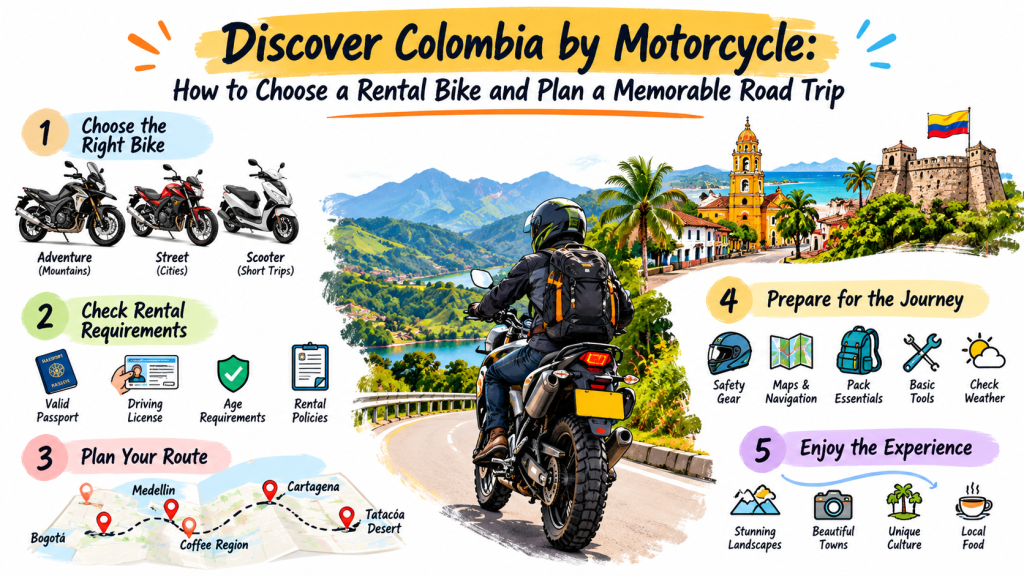
Introduction
Traveling through Colombia by motorcycle offers a different way to experience the country’s cities, mountain landscapes, small towns, and coastal regions. Instead of depending entirely on fixed transport schedules, riders can plan their own stops and adjust their journeys as they go.
However, a rewarding motorcycle trip requires careful preparation. Traffic conditions change between cities and rural areas, mountain roads demand attention, and rain can affect visibility and traction. Rental rules, insurance coverage, and vehicle condition also influence how smoothly your journey unfolds.
The best approach starts with a clear travel plan. You need to choose a motorcycle that matches your experience, identify realistic destinations, understand the rental agreement, and prepare for unexpected delays.
This guide explains how to organize motorcycle travel in Colombia, compare rental options, manage expenses, and make practical decisions before setting off.
1. Decide What Kind of Motorcycle Journey You Want
Before searching for a rental, determine the type of trip you want to take. Your preferred destinations, available time, and riding experience will influence nearly every decision.
City exploration and short rides
If you mainly want to explore urban attractions or nearby towns, a smaller motorcycle may offer enough performance. Its manageable size can help with parking and low-speed maneuvering.
Consider your daily travel needs carefully. You may need a different motorcycle if you plan to carry a passenger, travel with luggage, or leave the city for winding mountain roads.
For short journeys, compare the motorcycle’s fuel consumption, seat comfort, storage capacity, and ease of handling. Avoid paying for features that do not support your actual plans.
Weekend trips and regional exploration
A weekend journey requires more preparation than a short city ride. You must consider fuel availability, overnight accommodation, changing weather, and the condition of roads outside urban areas.
Choose a motorcycle that remains comfortable throughout your planned riding day. Check whether you can carry your luggage securely without affecting balance or exceeding the vehicle’s limits.
Keep your schedule flexible enough to accommodate traffic, roadworks, and rest breaks.
Longer motorcycle adventures
Multi-day journeys demand greater attention to mechanical condition, rider fatigue, and breakdown support.
A touring motorcycle may provide useful comfort and luggage capacity. An adventure motorcycle may suit routes with varied surfaces, depending on its specifications and permitted use.
Neither option automatically suits every rider. Choose a model you can control confidently, including when maneuvering at low speeds or stopping on uneven ground.
2. Match the Motorcycle to Your Route
A suitable motorcycle should meet the demands of your route without creating unnecessary difficulty.
| Motorcycle type | Suitable uses | Main consideration |
|---|---|---|
| Commuter motorcycle | City travel and shorter journeys | Comfort and performance over longer distances |
| Touring motorcycle | Extended paved-road journeys | Weight, seat height, and handling |
| Adventure motorcycle | Selected routes with varied surfaces | Ground clearance, tires, and permitted road use |
| Scooter | Short urban trips and local sightseeing | Engine capacity, road suitability, and luggage limits |
Use this comparison as a starting point, not a guarantee of suitability. Individual models can differ significantly in performance, braking, weight, and equipment.
Before confirming a rental, ask the provider about the exact model, luggage arrangements, fuel requirements, and maintenance condition.
If your itinerary includes rough roads, confirm that the motorcycle can handle them and that the rental agreement permits such travel. Do not assume that an adventure motorcycle is suitable for every unpaved route.
3. Choose a Convenient Rental Location
Your pickup location can affect your first day’s schedule, transport costs, and the routes you can realistically explore.
Starting from Medellín
Medellín can provide a starting point for journeys into surrounding mountain regions and nearby towns. However, riders must account for city traffic, elevation changes, and winding roads beyond the urban area.
Before leaving, review the forecast for your destination and identify suitable fuel stops. If you are unfamiliar with mountain riding, begin with a manageable route instead of immediately attempting a demanding journey.
Motorcycle rental in Medellín may suit travelers who want flexibility, but the motorcycle must match the terrain and their experience.
Starting from Bogotá
Bogotá provides access to destinations in the surrounding highlands. Traffic, elevation, and changing weather can influence travel time and rider comfort.
Plan enough time to leave the city without rushing. Check road conditions before heading into the mountains, and avoid setting an arrival time that forces you to ride while tired.
If you are unfamiliar with the area, choose a route with practical stopping points and accessible services.
Starting from Cartagena
Cartagena may suit visitors who want to explore the city and selected coastal destinations.
Warm conditions make hydration and suitable protective clothing important. Traffic, road surfaces, and rain can still affect local journeys.
Before leaving Cartagena for a longer ride, confirm that your motorcycle suits the planned distance and that the rental agreement allows travel to your intended destination.
Compare pickup and return arrangements
Before booking, check whether the provider’s pickup location fits your itinerary. Confirm the opening hours, collection procedure, return deadline, and process for reporting delays.
Also, ask how the provider handles assistance outside the pickup city. Support arrangements may differ by provider and location.
4. Confirm Your Licence and Rental Eligibility
International visitors should verify their eligibility before paying for a motorcycle rental.
Colombian driving requirements may depend on nationality, residency, licence category, vehicle type, and other circumstances. Rental providers may also impose their own age and experience conditions.
Check your licence category
Make sure your licence covers the motorcycle you intend to ride. Ask the provider which documents it accepts from foreign visitors and whether additional documentation applies.
Depending on your circumstances, you may need an international driving permit or other supporting documents. An international driving permit does not replace your original licence.
Confirm the current requirements with the relevant Colombian authority before departure. Do not rely solely on an informal assurance from a rental provider when a legal requirement remains unclear.
Review the provider’s eligibility rules
Ask about the minimum rental age, required riding experience, licence history, and accepted payment methods.
Clarify these points before booking:
- Which identification documents must you present?
- Does the provider require a security deposit?
- Can another person ride the motorcycle?
- Are there restrictions on engine size or travel areas?
- What happens if your plans require a rental extension?
- What cancellation conditions apply?
Keep written confirmation of important requirements so you can resolve any uncertainty before collection.
5. Work Out the Full Cost of Renting a Motorcycle
The rental rate is only one part of your travel budget. Fuel, insurance, equipment, accommodation, food, parking, and unexpected expenses can increase the total.
A careful budget helps you compare options on their overall value rather than the advertised daily rate alone.
Build a practical budget
| Expense | What to include |
|---|---|
| Rental fee | Daily rate and full rental duration |
| Deposit | Amount, payment method, and refund conditions |
| Insurance | Coverage, exclusions, and deductible |
| Fuel | Expected consumption and planned distance |
| Protective gear | Helmet, gloves, clothing, and other equipment |
| Accommodation | Overnight stays and possible delays |
| Road expenses | Parking, applicable tolls, and other charges |
| Emergency reserve | Alternative transport, repairs, or extra nights |
Prices vary by location, motorcycle model, season, rental period, and provider. Request a current, itemized quote instead of assuming that a price from another city or trip will apply.
Understand the security deposit
Before paying a deposit, confirm the amount and how the provider will hold or process it. Ask when the provider expects to release the funds and which circumstances may lead to deductions.
Photograph the motorcycle at pickup and keep a copy of the handover record. Retain your payment records until the provider has settled the deposit.
Read the insurance conditions
Insurance policies can differ in important ways. Check coverage for third-party liability, damage to the rental motorcycle, theft, and roadside assistance.
Ask about deductibles, exclusions, and your financial responsibility after an accident or mechanical incident. Confirm whether coverage applies to your planned destinations and permitted road surfaces.
Never assume that a policy covers every type of damage or that roadside assistance includes a replacement motorcycle.
6. Inspect the Motorcycle Before You Accept It
A rental motorcycle should be in suitable condition before you begin your journey. Take time to inspect it with the provider and record any existing damage.
Complete a pre-departure inspection
- Tires: Look for visible damage, unusual wear, and signs of underinflation. Ask the provider to confirm the correct tire pressure.
- Brakes: Check the brake controls and ask the provider to address anything that feels abnormal.
- Lights and indicators: Confirm that the headlight, brake light, and turn signals work.
- Controls: Check the mirrors, throttle, clutch, horn, and other controls.
- Visible damage: Photograph scratches, dents, broken parts, and other existing defects.
- Fluid leaks: Look for visible leaks and report any concerns before riding.
- Documents: Confirm that you have the vehicle documents required for lawful use.
- Safety equipment: Check the condition and fit of any helmet or protective gear supplied.
- Emergency support: Save the provider’s contact details and breakdown instructions.
Ask the provider to record existing damage in the handover documentation. Do not accept a motorcycle with a serious mechanical fault or defective safety equipment.
A short inspection cannot guarantee that a vehicle will remain trouble-free. However, it can help identify visible problems and establish a record of the motorcycle’s condition.
7. Plan a Route That Allows for Realistic Travel Times
Colombia’s varied geography makes route planning especially important. A relatively short distance may involve mountain bends, steep climbs, congestion, construction, or slow-moving traffic.
Avoid choosing daily destinations based only on the distance displayed on a map.
Limit unnecessary stops
Choose a main destination for each day and identify practical alternatives along the route. Too many planned stops can make you rush, particularly when weather or traffic causes delays.
For a first trip, consider exploring one region rather than attempting to cross several distant areas in a short period.
Plan fuel stops before leaving
Fuel availability may become less convenient in rural areas. Estimate your motorcycle’s practical range and identify suitable stations before entering less-developed stretches.
Actual fuel consumption can vary with elevation, traffic, luggage, and riding style. Refuel early enough to maintain a reasonable reserve.
Allow time for rest
Plan breaks for food, hydration, and stretching. Fatigue can reduce concentration and reaction time, even when the road appears familiar.
If you feel sleepy, unwell, or distracted, stop at a suitable location. Do not continue simply to meet a planned arrival time.
8. Prepare for Rain, Mountain Roads, and Traffic
Weather and road conditions can change during a single journey. A sunny departure does not guarantee that the entire route will remain dry.
Rain can reduce traction and visibility. Potholes, loose gravel, blind bends, and steep descents require careful attention.
Before each major ride, check the latest available weather forecast and road information. Adjust your itinerary if conditions make the planned route unsuitable.
During the journey:
- Reduce speed when visibility or traction deteriorates.
- Leave enough space between your motorcycle and other vehicles.
- Avoid sudden braking or steering on slippery surfaces.
- Approach blind bends cautiously and remain within your lane.
- Stop somewhere safe if conditions become difficult.
- Postpone travel when hazards exceed your ability to manage them.
Do not rely on a navigation app alone. It may not reflect recent road closures, construction, or other hazards.
9. Pack for Safety and Comfort
Your luggage should support the journey without making the motorcycle difficult to control.
Carry only what you need and secure your bags according to the motorcycle’s luggage limits. Keep heavier items low and balanced.
Items to prepare
- A properly fitting helmet that meets applicable requirements.
- Protective gloves and suitable riding footwear.
- Abrasion-resistant riding clothing.
- Rain protection suited to the expected conditions.
- Drinking water and personal supplies.
- A small first-aid kit.
- A phone charger or suitable power bank.
- Required identification and rental documents.
- Emergency contact details saved offline.
- Basic repair equipment appropriate for the motorcycle and your experience.
Confirm which items the provider supplies before departure. Inspect all supplied protective equipment rather than assuming it meets your needs.
Protect important documents and electronic devices from rain. Secure digital copies can provide a backup, but they do not replace original documents when required by authorities or the rental agreement.
10. Know What to Do If Something Goes Wrong
Mechanical faults, road closures, bad weather, and injuries can disrupt even a carefully planned trip.
Before leaving, ask the provider how it handles breakdowns. Confirm whether support includes roadside repairs, recovery, or a replacement motorcycle. Check geographic limits, operating hours, and possible charges.
If your motorcycle develops a serious fault, move to a safe location when possible and contact the provider. Avoid attempting repairs beyond your ability or working beside active traffic.
For an emergency involving injury or immediate danger, contact the appropriate local emergency service. Share your location and follow the instructions of emergency responders.
Keep an emergency reserve for alternative transport, accommodation, or other unexpected expenses. A flexible schedule can help you respond without making rushed decisions.
11. Decide Whether a Motorcycle, Scooter, or Car Fits Your Needs
The best vehicle depends on your passengers, luggage, route, experience, and budget.
A motorcycle may suit a solo traveler who wants flexibility and has the necessary riding skills. A scooter may work for short local journeys, depending on its capabilities and the permitted roads.
A car rental in Colombia may suit families, groups, or travelers who need extra luggage space and greater protection from weather.
| Travel situation | Option to consider | Main limitation |
|---|---|---|
| Solo city exploration | Small motorcycle or scooter | Less protection from weather and traffic |
| Longer paved-road journey | Suitable touring motorcycle | Weight and fatigue require consideration |
| Varied road surfaces | Appropriate adventure motorcycle | Not every model suits rough roads |
| Family travel | Car | Fuel and parking can add costs |
| Group travel with luggage | Car with sufficient capacity | Space and road suitability need checking |
| Short local sightseeing | Scooter or public transport | Depends on the destination and journey |
For scooter rental in Colombia, confirm licence requirements, road restrictions, insurance terms, and the scooter’s practical capabilities. Do not assume that a scooter suitable for city travel is also suitable for a long-distance journey.
Choose the vehicle that supports your entire itinerary rather than only your first stop.
12. Common Mistakes to Avoid
Booking before checking your documents
Confirm your licence category and eligibility before paying. A booking does not guarantee that you meet every legal requirement or provider condition.
Choosing a motorcycle only because it costs less
Consider comfort, condition, insurance, luggage capacity, and support. The lowest rental price may not offer the best value for your journey.
Underestimating the route
Mountain roads and changing traffic can increase travel time. Plan realistic daily distances and avoid scheduling activities immediately after long rides.
Overlooking insurance exclusions
Read the actual policy conditions. Confirm whether the planned route, motorcycle use, and additional riders fall within the permitted coverage.
Ignoring existing damage
Photograph the motorcycle before departure and ensure that the provider records visible defects. Keep the evidence until the rental has ended.
Returning the motorcycle without checking the procedure
Confirm the return location, deadline, fuel policy, and equipment requirements. Allow time for the final inspection and retain confirmation that you returned the vehicle.
Important Considerations Before Departure
Before starting your journey, review the factors that could affect your eligibility, budget, and safety.
- Legal compliance: Confirm the current Colombian driving requirements that apply to your circumstances.
- Insurance: Understand coverage, exclusions, deductibles, and responsibility for damage.
- Weather: Review forecasts and adjust your plans when conditions change.
- Vehicle condition: Check tires, brakes, lights, controls, and required documents.
- Financial readiness: Maintain a reserve for delays, repairs, and alternative transport.
- Communication: Save provider contact details and accommodation information before entering areas with limited coverage.
- Personal readiness: Rest adequately, wear suitable protective equipment, and never ride while impaired or too tired to concentrate.
These preparations cannot eliminate every risk. However, they can help you recognize problems earlier and respond more effectively.
Frequently Asked Questions (FAQs)
1. What type of motorcycle should I rent in Colombia?
Choose a motorcycle based on your experience, route, luggage, and comfort needs. A commuter motorcycle may suit short trips, while a touring or adventure model may work better for longer journeys. Confirm the model’s condition and capabilities before booking.
2. Can international visitors rent motorcycles in Colombia?
International visitors may qualify if they meet the applicable legal requirements and the rental provider’s conditions. Confirm your licence category, identification documents, minimum age, and any additional requirements before paying.
3. Do I need an international driving permit?
Requirements depend on your nationality, residency, licence, and circumstances. Check the current rules with the relevant Colombian authority and your rental provider. An international driving permit does not replace your original licence.
4. How much does motorcycle rental cost in Colombia?
Rental prices vary by location, motorcycle model, season, rental duration, and provider. Request an itemized quote and budget separately for fuel, insurance, equipment, accommodation, and unexpected expenses.
5. Can I explore nearby destinations from Medellín by motorcycle?
Yes, Medellín can serve as a starting point for regional journeys. However, mountain roads, traffic, and changing weather require preparation. Select routes that match your experience and verify current conditions before departure.
6. Is Bogotá a practical starting point for motorcycle travel?
Bogotá offers access to destinations in the surrounding highlands. Plan for traffic, elevation, and possible weather changes. Choose suitable routes and avoid riding beyond your ability or comfort level.
7. Can I rent an adventure motorcycle for rural journeys?
Availability depends on the rental provider and location. Confirm the motorcycle’s capabilities, permitted travel areas, insurance restrictions, and breakdown arrangements before choosing a rural route.
8. What should motorcycle rental insurance cover?
Review third-party liability, damage to the rented motorcycle, theft, and roadside assistance. Check exclusions, deductibles, and your financial responsibilities. Ask the provider to clarify any conditions you do not understand.
9. Should I choose a motorcycle or a car for my trip?
A motorcycle may suit solo travelers with appropriate riding experience. A car may better meet the needs of families, groups, or travelers with substantial luggage. Compare total costs, route conditions, comfort, and passenger requirements.
10. What should I check before accepting a rental motorcycle?
Inspect the tires, brakes, lights, mirrors, controls, and visible body damage. Confirm the required documents and inspect any supplied safety equipment. Photograph existing defects and ask the provider to record them.
11. What should I do if the motorcycle breaks down?
Move to a safe location when possible and contact the rental provider. Follow the agreed breakdown procedure and confirm the available assistance. Do not attempt repairs beyond your ability or put yourself in danger beside traffic.
12. How can I prepare for changing weather during my trip?
Check the forecast before each major ride, carry suitable rain protection, and leave room in your schedule for delays. Reduce speed when conditions deteriorate and stop if visibility or traction becomes unsafe.
Conclusion
Exploring Colombia by motorcycle can offer flexibility and access to destinations beyond the usual urban routes. However, the quality of your journey depends on how well you prepare for the road, the weather, and the responsibilities that come with renting a vehicle.
Choose a motorcycle that matches your experience, confirm your licence requirements, inspect the vehicle, and understand the rental agreement. Plan manageable daily distances, identify fuel stops, and prepare for unexpected expenses or delays.
When comparing options through MotoShare.co or other rental providers, review the actual vehicle details, availability, insurance conditions, and support arrangements before making a decision.
A well-planned trip does not require an ambitious schedule. It requires sensible choices, enough time to respond to changing conditions, and a commitment to riding within your abilities.
