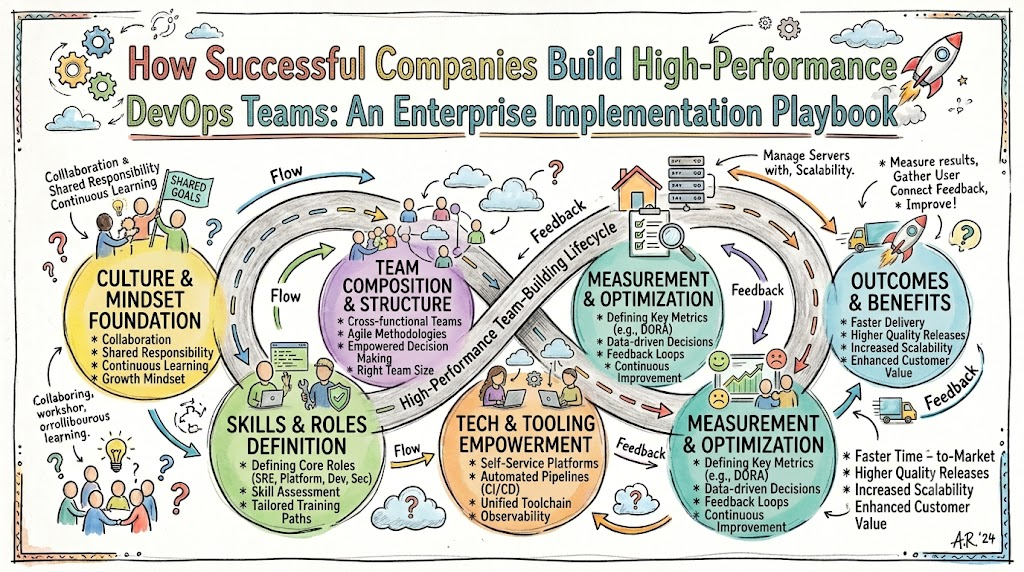
Introduction
Every modern organization wants to deliver software faster, improve customer satisfaction, reduce downtime, and respond quickly to changing business requirements. While DevOps has become the preferred operating model for achieving these goals, implementing it successfully is often more challenging than expected.
Some organizations purchase new automation tools but continue to rely on manual processes. Others migrate applications to the cloud without improving release management or operational reliability. In many cases, engineering teams adopt Kubernetes or CI/CD platforms but struggle to achieve measurable improvements because culture, governance, and training have not evolved alongside technology.
This article explores how successful organizations approach DevOps implementation through a structured transformation model. Rather than focusing only on tools, it explains how engineering leaders build scalable processes, develop team capabilities, and create reliable software delivery systems that support long-term business growth.
Phase One: Understanding the Current Engineering Environment
Every successful transformation begins with a clear understanding of the current state.
Before introducing automation or cloud-native technologies, organizations evaluate how software is built, tested, deployed, and maintained.
Typical assessment areas include:
- Application architecture
- Development workflow
- Deployment process
- Infrastructure management
- Cloud readiness
- Security practices
- Monitoring capabilities
- Team collaboration
- Release frequency
- Incident history
This assessment provides a realistic baseline and helps leadership prioritize improvements.
Phase Two: Aligning Technology with Business Goals
Successful organizations avoid implementing technology simply because it is popular.
Instead, engineering initiatives are aligned with measurable business objectives such as:
- Reducing deployment time
- Increasing release frequency
- Improving application availability
- Enhancing customer experience
- Strengthening security
- Reducing infrastructure costs
- Accelerating product innovation
When technical improvements support business priorities, organizational adoption becomes much easier.
Phase Three: Standardizing Software Development
One of the first improvements many organizations make is standardizing software development practices.
Teams establish consistent approaches for:
- Source code management
- Branching strategies
- Code reviews
- Automated testing
- Build validation
- Artifact management
Standardization reduces complexity and enables automation across multiple development teams.
Phase Four: Building Reliable Delivery Pipelines
Instead of relying on manual deployments, successful organizations create automated CI/CD pipelines that perform repetitive tasks consistently.
A mature delivery pipeline typically includes:
- Source code validation
- Automated builds
- Unit testing
- Static analysis
- Security scanning
- Artifact publishing
- Deployment automation
- Environment verification
Reliable pipelines improve deployment confidence while reducing operational risk.
Phase Five: Automating Infrastructure
Infrastructure automation is another common milestone.
Rather than configuring servers manually, engineering teams define environments using Infrastructure as Code.
Benefits include:
- Faster provisioning
- Consistent environments
- Version-controlled infrastructure
- Easier disaster recovery
- Reduced configuration drift
Automation enables teams to spend more time improving applications instead of maintaining infrastructure manually.
Phase Six: Modernizing Application Deployment
As applications become increasingly distributed, organizations frequently adopt containers to simplify deployment.
Containers provide:
- Consistent runtime environments
- Faster deployments
- Better scalability
- Improved portability
- Simplified dependency management
Container adoption often creates the foundation for Kubernetes implementation.
Phase Seven: Operating Kubernetes at Scale
Deploying Kubernetes is only the beginning.
Successful organizations establish operational standards covering:
- Cluster governance
- Resource management
- Access control
- Networking
- Storage
- Security
- Backup strategies
- Upgrade procedures
- Monitoring
Well-managed Kubernetes environments provide reliability without introducing unnecessary operational complexity.
Phase Eight: Integrating Security Throughout Delivery
Organizations increasingly recognize that security cannot remain separate from software development.
Instead of conducting security reviews only before production releases, modern engineering teams integrate automated validation into every stage of the software lifecycle.
Typical DevSecOps activities include:
- Source code scanning
- Dependency analysis
- Container security
- Infrastructure validation
- Secret management
- Compliance automation
Embedding security into daily engineering practices reduces long-term operational risk.
Phase Nine: Building Reliable Operations
As deployment frequency increases, operational maturity becomes increasingly important.
Successful organizations adopt reliability practices such as:
- Service availability objectives
- Error budget management
- Automated alerting
- Incident response
- Root cause analysis
- Capacity planning
These practices improve customer experience while enabling continuous software delivery.
Phase Ten: Investing in People
Technology alone does not create high-performing engineering teams.
Organizations that sustain long-term success invest heavily in continuous learning.
Professional development initiatives commonly include:
- Internal workshops
- Hands-on laboratories
- Cloud training
- Kubernetes education
- DevSecOps coaching
- Leadership mentoring
Continuous education ensures engineering teams remain prepared for evolving technologies.
The Importance of Technical Leadership
Strong technical leadership helps organizations navigate complex transformation initiatives.
Experienced DevOps leaders assist with:
- Architecture planning
- Automation strategy
- Cloud adoption
- Engineering standards
- Team mentoring
- Governance
- Performance measurement
Leadership provides consistency across large engineering organizations.
Measuring Success
Successful DevOps adoption should produce measurable improvements.
Organizations commonly evaluate progress using indicators such as:
- Deployment frequency
- Release lead time
- Recovery speed
- Change success rate
- Infrastructure reliability
- Security compliance
- Developer productivity
- Customer satisfaction
Measurement transforms DevOps into a continuous improvement process rather than a one-time implementation project.
Emerging Enterprise Trends
Engineering organizations continue to expand beyond traditional DevOps practices.
Current areas of investment include:
- Platform Engineering
- Internal Developer Platforms
- GitOps
- FinOps
- AI-assisted Operations
- Policy as Code
- Cloud Governance
- Intelligent Automation
These disciplines help organizations simplify operations while supporting continued business growth.
Building a Sustainable DevOps Culture
Long-term success depends on creating an environment where continuous improvement becomes part of everyday engineering work.
Organizations encourage:
- Knowledge sharing
- Experimentation
- Automation
- Cross-functional collaboration
- Documentation
- Learning from incidents
- Incremental improvement
A healthy engineering culture supports both innovation and operational excellence.
Conclusion
High-performing DevOps organizations do not achieve success through technology alone. Their results come from combining clear business objectives, standardized engineering practices, infrastructure automation, cloud-native platforms, integrated security, operational excellence, and continuous learning.
By approaching DevOps as a long-term organizational capability rather than a collection of tools, businesses create engineering teams that deliver software more efficiently, respond rapidly to change, and support sustainable digital transformation.
Whether an organization is beginning its modernization journey or expanding existing DevOps initiatives, investing in structured implementation, technical leadership, and continuous skill development creates lasting value for both engineering teams and the business.
Frequently Asked Questions
Why do many DevOps projects fail?
Common reasons include focusing on tools instead of processes, insufficient automation, limited collaboration, inadequate training, and unclear business objectives.
What is the first step in enterprise DevOps adoption?
A comprehensive assessment of existing development, infrastructure, operations, and security practices provides the foundation for an effective implementation strategy.
Why is Infrastructure as Code important?
Infrastructure as Code improves consistency, automation, disaster recovery, and collaboration while reducing manual configuration errors.
How does DevSecOps improve software delivery?
DevSecOps integrates automated security validation throughout development, enabling organizations to identify vulnerabilities earlier without slowing delivery.
Why should organizations invest in DevOps training?
Continuous training helps engineering teams build practical skills, adapt to evolving technologies, and successfully implement cloud-native engineering practices.
