Tag: #DevOpsCareer

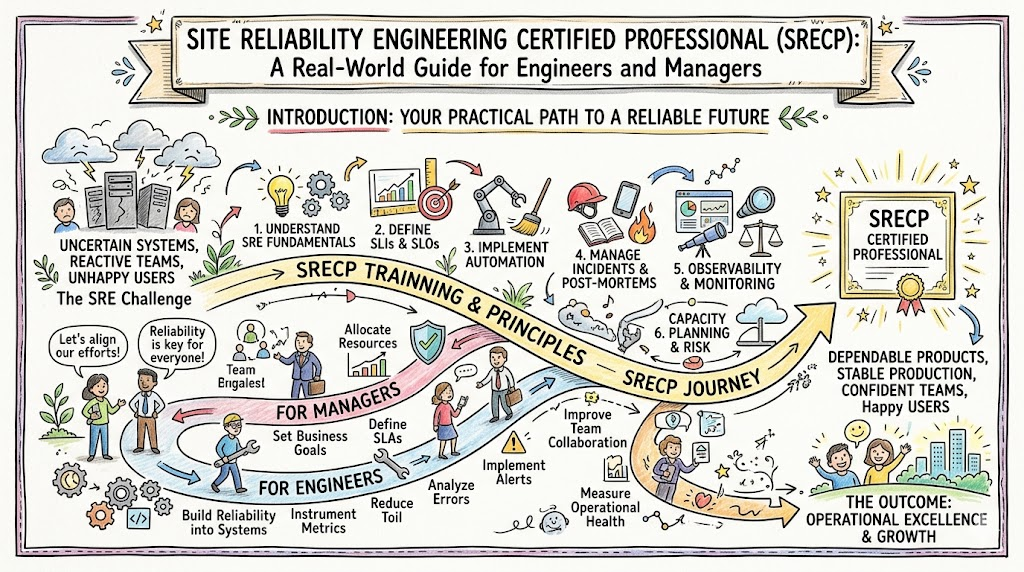
  • Site Reliability Engineering Certified Professional (SRECP): A Real-World Guide for Engineers and Managers

    Introduction

    Software has become the backbone of almost every business. Whether it is banking, healthcare, retail, education, telecom, media, or SaaS, users expect systems to work all the time. They expect fast response, smooth transactions, secure access, and stable performance. They do not think about servers, pipelines, containers, or cloud architecture. They only care whether the service works.

    That simple expectation creates a serious challenge for engineering teams.

    Modern applications are not small or simple anymore. They run across cloud infrastructure, container platforms, APIs, distributed services, databases, CI/CD pipelines, and observability systems. Teams release changes faster than before. Environments scale quickly. Dependencies are deeper. A single failure can travel across services and affect thousands or even millions of users.

    This is why reliability is no longer only an operations problem. It is an engineering responsibility.

    Site Reliability Engineering, usually called SRE, gives teams a practical way to manage this challenge. It helps them think clearly about uptime, performance, resilience, incident response, alert quality, automation, and service goals. Instead of relying only on manual support and reactive fixes, SRE creates a more disciplined way of running production systems.

    For working engineers, SRE brings structure to the way systems are built and supported.

    For managers, SRE creates a better language for discussing service quality, risk, platform maturity, and business impact.

    The Site Reliability Engineering Certified Professional, or SRECP, is designed for professionals who want to learn this discipline in a structured and practical way. It is useful for people who want more than general DevOps or operations awareness. It helps them understand how reliability is measured, improved, and managed in real environments.

    This guide explains the SRECP certification from a practical career point of view. It covers what the certification means, why it matters, why certifications are valuable, why DevOpsSchool is a strong option, what skills you gain, who should take it, how to prepare, what learning path to choose, and what to do next after completing it.


    What is Site Reliability Engineering Certified Professional (SRECP)?

    Site Reliability Engineering Certified Professional is a professional certification for people who want to build strong skills in modern reliability engineering. It is designed to help learners understand how reliable systems are created, operated, measured, and improved in production environments.

    In simple terms, SRECP teaches you how to support software systems in a smarter and more measurable way.

    That is important because many professionals already do work related to reliability without using a complete reliability framework. A DevOps engineer may work on automation and deployment. A cloud engineer may focus on uptime and infrastructure. A platform engineer may manage shared services. A system administrator may handle incident support. A manager may track escalations and service quality. All of them touch reliability, but often in separate pieces.

    SRECP helps bring these pieces together.

    It teaches professionals to think beyond tasks and tools. Instead of only asking, “How do I fix this issue?” they begin asking better questions:

    What level of service should users expect?

    How do we measure whether the service is healthy?

    How much risk can we take when releasing changes?

    Which operational work should be automated?

    How do we reduce repeated failures?

    How do we respond to incidents without creating more chaos?

    That shift is what makes this certification valuable. It helps people move from general production support into a more mature reliability mindset.

    Official certification link: https://www.devopsschool.com/certification/sre-certified-professional-srecp.html


    Why it Matters in Today’s Software, Cloud, and Automation Ecosystem

    Today’s software ecosystem is fast, distributed, and always changing. Applications now depend on cloud services, infrastructure as code, container orchestration, monitoring tools, service meshes, CI/CD pipelines, and many other moving parts. This gives teams speed and flexibility, but it also creates complexity.

    When complexity rises, failures become harder to predict.

    A small bug may trigger latency. A weak deployment process may create downtime. Poor monitoring may hide a real issue until customers complain. Noisy alerting may exhaust teams. A missing service objective may create confusion about what “good enough” really means. Manual operational work may slow down response and increase human error.

    This is why SRE matters.

    SRE provides a practical model for handling reliability in modern systems. It helps teams balance speed and stability. It helps them define useful service expectations. It encourages automation over repetitive toil. It improves incident handling. It creates better observability. Most importantly, it teaches teams to manage reliability intentionally instead of hoping that things stay stable.

    This has clear value for both engineers and managers.

    For engineers, SRE makes day-to-day technical work more meaningful. It connects monitoring, automation, deployment safety, and platform operations to real service outcomes.

    For managers, SRE creates a framework for conversations around uptime, support load, operational maturity, customer experience, and engineering effectiveness.

    In short, SRE matters because businesses can no longer treat reliability as an afterthought. Reliability is now part of product quality, customer trust, and business continuity.


    Why Certifications are Important for Engineers and Managers

    A certification does not replace real work, but it can make real work more structured and more valuable.

    Many professionals learn from daily experience. That is a good thing. However, experience can sometimes be incomplete. Someone may become very strong in one tool or process while still missing the larger reliability picture. Another person may be good at firefighting but weak in prevention. Another may understand infrastructure but not know how to define service quality.

    Certification helps solve that problem by creating an organized learning path.

    For engineers, certification offers several benefits.

    It gives direction. Instead of studying random topics, professionals can follow a clear progression.

    It builds confidence. Many engineers already do part of the work, but a certification helps them see how those parts fit into a complete system.

    It supports career visibility. A role-relevant certification can make growth easier to explain to employers and hiring teams.

    It also helps fill gaps. An engineer who understands dashboards but not service objectives can improve that weakness. An engineer who knows deployment automation but not incident discipline can close that gap too.

    For managers, certification offers a different type of value.

    Managers need shared language. They need to understand how reliability should be measured, how operational risk should be discussed, and how teams can mature over time. They also need a better way to support hiring, mentoring, and capability building.

    A strong certification helps both engineers and managers develop a more complete understanding of modern system reliability. It does not create mastery on its own, but it gives structure to learning and makes future growth more focused.


    Why Choose DevOpsSchool?

    DevOpsSchool is widely known for role-focused technical learning. That matters because people pursuing SRECP are usually not complete beginners. They are often working engineers, technical leads, architects, operations professionals, or managers who want practical learning that matches real engineering environments.

    Another strength is that the learning style is generally aligned with real job needs. A good SRE certification should not feel isolated from cloud operations, CI/CD, observability, automation, incidents, and service support. It should feel connected to actual work. That is where DevOpsSchool becomes useful for many learners.

    It is also a suitable choice for mixed audiences. Some learners need strong technical understanding. Others need enough depth to guide teams and make better operational decisions. A provider that can support both groups adds real value.

    For professionals who want a reliability certification with career relevance, practical direction, and a modern engineering focus, DevOpsSchool is a meaningful option.


    Certification Deep-Dive: Site Reliability Engineering Certified Professional (SRECP)

    What is this certification?

    SRECP is a professional certification that helps learners understand how reliability should be approached in modern software systems. It brings together engineering thinking, operational discipline, observability awareness, automation habits, and service-level understanding.

    It is not just about keeping systems alive.

    It is about learning how to make services dependable, measurable, supportable, and scalable in the real world.

    This certification helps learners understand not just how to respond to problems, but how to build systems and practices that reduce problems over time.

    Who should take this certification?

    This certification is useful for a broad range of professionals.

    It is a strong option for DevOps engineers who want deeper production and reliability knowledge.

    It is a natural fit for SRE aspirants who want a structured learning path.

    It is valuable for platform engineers responsible for internal systems, uptime, and service operations.

    It helps cloud engineers who manage performance, availability, and support readiness.

    It can also support operations professionals who want to move from manual support work into more engineering-led operations.

    Engineering managers can benefit too, especially if they are responsible for service quality, incident readiness, escalation flow, and operational maturity.

    Even software engineers can gain value from this certification when they work closely with production environments and care about system behavior after deployment.


    Certification Overview Table

    Certification NameTrackLevelWho it’s forPrerequisitesSkills coveredRecommended orderLink
    Site Reliability Engineering Certified Professional (SRECP)SREProfessionalDevOps engineers, SRE aspirants, platform engineers, cloud engineers, operations professionals, engineering managersBasic knowledge of Linux, cloud, monitoring, CI/CD, and production environments is helpfulReliability engineering, observability, incident handling, service objectives, automation, operational maturity, production stabilityA strong starting point for the SRE trackhttps://www.devopsschool.com/certification/sre-certified-professional-srecp.html

    Site Reliability Engineering Certified Professional (SRECP)

    What it is

    SRECP is a structured certification path for professionals who want to build serious capability in service reliability and production operations. It teaches how reliability is defined, supported, observed, and improved in modern engineering environments.

    It is useful for people who want to move from reactive operations into reliability-driven engineering.

    Who should take it

    • DevOps engineers
    • SRE aspirants
    • Platform engineers
    • Cloud engineers
    • Operations professionals
    • System administrators
    • Technical leads
    • Engineering managers
    • Software engineers who work near production systems

    Skills you’ll gain

    • Clear understanding of Site Reliability Engineering principles
    • Better thinking around service quality and service expectations
    • Ability to understand and use service-level concepts
    • Improved incident response mindset
    • Stronger observability awareness
    • Better alerting judgment
    • Stronger automation-first thinking
    • Better understanding of operational toil and how to reduce it
    • Improved production support maturity
    • Better alignment between technical work and customer impact

    Real-world projects you should be able to do after it

    • Define service reliability goals for an application
    • Create basic health dashboards for services or platforms
    • Improve alert quality so teams focus on real problems
    • Support a simple incident response workflow
    • Review repeated support pain points and identify automation opportunities
    • Improve production readiness before deployments
    • Build better visibility into system health and performance
    • Introduce reliability discussions into release planning
    • Help platform teams improve operational discipline
    • Contribute to service-improvement initiatives in production

    Preparation plan

    7–14 days

    This preparation plan is best for professionals who already work in DevOps, cloud, operations, or platform roles. In this short window, focus on targeted revision. Review reliability basics, incident concepts, service objectives, observability, alerting, and automation. This path works only if you already have practical industry exposure.

    30 days

    This is the most balanced plan for working professionals. Spend the first part building conceptual clarity. Use the second part to connect theory with real production scenarios. Use the final phase for revision, practice notes, and practical case understanding. This approach helps build real understanding instead of surface-level memorization.

    60 days

    This plan is best for beginners or professionals changing roles. Start with Linux, cloud fundamentals, monitoring basics, CI/CD, containers, and production support. Then move into SRE concepts, service quality thinking, incidents, observability, and automation. Finish with mini-projects, review, and deeper topic revision.

    Common mistakes

    • Thinking SRE is only about monitoring
    • Learning tools without understanding why they matter
    • Ignoring service-level concepts
    • Focusing only on incident response and not prevention
    • Studying theory without practical use cases
    • Treating automation as optional
    • Preparing without linking topics to real production environments
    • Forgetting the business value of reliability

    Best next certification after this

    The next certification depends on your direction.

    If you want to stay close to the same domain, an observability-focused certification is a smart next step.

    If you want stronger cloud-native infrastructure depth, a Kubernetes-related certification is a strong choice.

    If you want broader delivery or leadership ownership, a DevOps or management-focused certification makes sense.


    Choose your path

    DevOps

    This path is ideal for professionals focused on delivery pipelines, automation, infrastructure, and release systems. SRECP adds reliability depth and helps DevOps professionals think beyond deployment into long-term service health.

    DevSecOps

    This path is useful for learners working in secure delivery environments. SRECP strengthens this direction by adding resilience, operational discipline, and better incident readiness to security-focused work.

    SRE

    This is the most direct and natural path for professionals who want to build careers in service reliability, observability, operational improvement, and incident management. SRECP is a strong foundation for this path.

    AIOps/MLOps

    This path suits professionals working with intelligent automation, machine learning platforms, or AI-supported operations. SRECP gives them the reliability discipline needed for complex, automated environments.

    DataOps

    Data systems also need reliable workflows, stable pipelines, and strong operational visibility. SRECP helps DataOps professionals bring service-quality thinking into data platform work.

    FinOps

    FinOps focuses on financial efficiency in cloud environments. Reliability supports this goal because unstable systems often create waste, repeated rework, emergency fixes, and poor resource usage. SRECP can therefore complement a FinOps learning path very well.


    Role → Recommended certifications mapping

    RoleRecommended certifications
    DevOps EngineerSRECP, DevOps-focused certifications, Kubernetes-related certifications
    SRESRECP first, then observability and advanced reliability certifications
    Platform EngineerSRECP plus Kubernetes, Terraform, and platform engineering learning
    Cloud EngineerSRECP plus cloud operations or architecture certifications
    Security EngineerDevSecOps certifications first, then SRECP for resilience and production depth
    Data EngineerDataOps learning plus SRECP for operational reliability
    FinOps PractitionerFinOps learning plus SRECP for stability and efficiency alignment
    Engineering ManagerSRECP plus leadership-focused DevOps, SRE, or platform strategy certifications

    Next certifications to take

    Same track

    An observability-focused certification is one of the best next moves after SRECP. Once you understand reliability concepts, stronger skills in metrics, logs, traces, dashboards, and telemetry design can make your practice much deeper.

    Cross-track

    A Kubernetes-related certification is a strong cross-track option. Many real production environments now rely on container orchestration, so deeper Kubernetes knowledge can make your reliability skills more practical.

    Leadership

    A DevOps or engineering-management-oriented certification is a good leadership path after SRECP. It is especially useful for professionals who want to move from individual execution into platform ownership, cross-team strategy, and operational governance.


    List of top institutions which provide help in training cum certifications for Site Reliability Engineering Certified Professional (SRECP)

    DevOpsSchool

    DevOpsSchool is the direct provider of the SRECP certification, so it is the most aligned option for learners who want official training support for this program. It is suitable for working professionals who want practical learning, structured guidance, and a certification path connected to real engineering work.

    Cotocus

    Cotocus can be useful for professionals looking for implementation-focused technical support and training. Learners who want stronger practical exposure around cloud, automation, and engineering workflows may find it helpful while building reliability-related skills.

    Scmgalaxy

    Scmgalaxy is known for technical learning in DevOps, automation, and engineering tools. It can be a helpful option for people who want to strengthen their fundamentals before moving deeper into specialized reliability areas.

    BestDevOps

    BestDevOps is often recognized in the wider DevOps and cloud training ecosystem. It can support professionals who want structured learning across automation, infrastructure, and engineering disciplines that connect well with SRE growth.

    devsecopsschool.com

    This platform can be valuable for professionals who want to combine reliability thinking with secure delivery practices. It is especially useful for environments where resilience and security need to support each other.

    sreschool.com

    SRESchool is naturally relevant for professionals who want a stronger and more focused path in reliability engineering. It can support learning in observability, service health, incident handling, and operational maturity.

    aiopsschool.com

    AIOpsSchool can be useful for learners interested in intelligent operations, analytics-based automation, and the future direction of operational engineering. It complements SRE well for advanced operations paths.

    dataopsschool.com

    DataOpsSchool is helpful for learners working on data platforms, data pipelines, and analytics systems. It can support professionals who want better reliability and operational consistency in data-driven environments.

    finopsschool.com

    FinOpsSchool is relevant for professionals focused on cloud cost control, optimization, and governance. Since stable systems often support better efficiency, it can be a useful complementary learning area for SRE-focused professionals.


    FAQs

    1. Is SRECP a beginner-level certification?

    It is better understood as a professional-level certification. Beginners can still take it, but they should allow more study time and strengthen their foundations first.

    2. How difficult is SRECP?

    It is moderate to challenging depending on your background. Professionals already working with cloud, DevOps, monitoring, or production support usually find it easier.

    3. How much preparation time is usually enough?

    For many working professionals, 30 days is a practical target. Experienced engineers may need less time. Beginners may need closer to 60 days.

    4. Do I need prior operations experience?

    It helps, but it is not the only valid path. DevOps, cloud engineering, platform work, system administration, and backend engineering can all support SRE learning.

    5. Is SRECP useful for software engineers?

    Yes. Software engineers who work closely with production systems, APIs, cloud deployments, or backend services can gain strong value from it.

    6. Is it only for people with the SRE job title?

    No. It is highly useful across DevOps, platform engineering, cloud operations, technical support, and management roles.

    7. Will it help with career growth?

    Yes. It can strengthen your profile for reliability-focused roles and improve your readiness for production ownership responsibilities.

    8. Is this certification useful for managers?

    Yes. Managers benefit because it gives them a clearer way to think about service quality, operational risk, and team maturity.

    9. What should I study before starting?

    Linux basics, cloud fundamentals, monitoring, containers, CI/CD, and production support concepts are all helpful starting points.

    10. Is SRECP only about monitoring and alerting?

    No. Monitoring is only one part. The certification also relates to service quality, incident discipline, automation, service objectives, and operational improvement.

    11. Should I take Kubernetes certification before SRECP?

    That depends on your role. If your work is more reliability-focused, SRECP is a strong first step. If you work deeply with Kubernetes every day, both paths can complement each other well.

    12. Will SRECP help in real-world projects?

    Yes. Its real value grows when you apply it to dashboards, alerting, incidents, automation, and service improvement work in production.


    FAQs on Site Reliability Engineering Certified Professional (SRECP)

    1. What does SRECP stand for?

    It stands for Site Reliability Engineering Certified Professional.

    2. What is the main goal of this certification?

    Its main goal is to help professionals understand and apply reliability engineering practices in modern production systems.

    3. Is SRECP good for DevOps engineers?

    Yes. It is one of the best next steps for DevOps professionals who want stronger production and reliability skills.

    4. Can managers benefit from SRECP?

    Yes. It helps managers better understand service health, reliability goals, incident readiness, and operational maturity.

    5. Is SRECP relevant in cloud-native environments?

    Yes. Cloud-native systems are exactly the kind of environments where structured reliability practices matter most.

    6. What makes it different from general operations learning?

    It focuses on engineering-led reliability instead of only manual support and reactive troubleshooting.

    7. Is SRECP useful for platform engineers?

    Yes. It can help platform engineers improve service stability, operational quality, and production discipline.

    8. What is the biggest value of SRECP?

    Its biggest value is that it turns scattered operational knowledge into a more complete and practical reliability mindset.


    Conclusion

    The Site Reliability Engineering Certified Professional certification is a strong and practical choice for professionals who want to grow in modern reliability engineering. It does not stay limited to one tool, one cloud platform, or one narrow support activity. Instead, it helps learners understand how service quality, observability, incidents, automation, and production stability connect in real engineering environments. That makes it useful for DevOps engineers, SRE aspirants, cloud professionals, platform teams, software engineers, and engineering managers. In a world where users expect systems to be available, fast, and dependable all the time, reliability has become one of the most valuable strengths a professional can build. SRECP offers a structured path to develop that strength in a practical and career-relevant way.

    #SRECP, #SiteReliabilityEngineering, #SRECertification, #DevOpsCareer, #CloudReliability,
  • From DevOps Practitioner to DevOps Architect: A Complete Career Guide

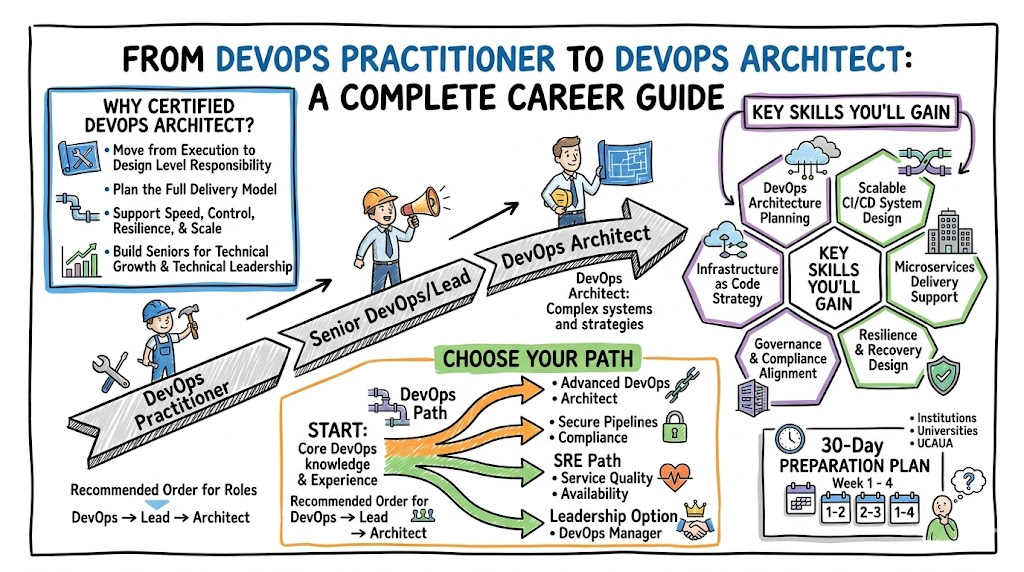
    Software delivery has become more demanding than ever. Teams are expected to release faster, reduce failures, improve security, manage cloud platforms well, and keep systems stable at the same time. In this kind of environment, companies do not only need professionals who know tools. They need people who can design the full delivery model that supports speed, control, resilience, and scale.

    That is the value of the Certified DevOps Architect certification.

    This certification is designed for professionals who want to move beyond execution-based work and step into design-level responsibility. It is not limited to pipeline setup, container handling, server automation, or cloud deployment alone. Instead, it focuses on how all these pieces should be planned and connected so engineering teams can work in a more reliable and organized way.

    For working engineers, it can become a strong step toward senior technical growth. For managers, it offers a better understanding of how delivery platforms should be built and improved. For cloud and platform professionals, it provides a practical route toward architecture-level thinking and responsibility.

    This guide explains the certification in simple language. It covers the overview, who should take it, what skills it builds, what kind of projects it prepares you for, how to study, what mistakes to avoid, what to do next, how to choose your path, and which institutions can support your learning.

    The provider is DevOpsSchool, and the official certification page is the reference point for the program details.


    Certification Overview

    CertificationProviderLevelBest For
    Certified DevOps ArchitectDevOpsSchoolAdvanced / ArchitectSenior DevOps engineers, platform engineers, cloud professionals, technical leads, architects, engineering managers

    Certification Table

    TrackLevelWho it’s forPrerequisitesSkills coveredRecommended order
    DevOpsArchitectSenior DevOps Engineers, Platform Engineers, Cloud Engineers, Infrastructure Professionals, Technical Leads, Engineering ManagersStrong DevOps basics, CI/CD exposure, cloud understanding, infrastructure awareness, automation experienceArchitecture design, delivery workflows, infrastructure as code, cloud strategy, microservices support, security thinking, resilience planning, governance, platform standardizationAfter DevOps fundamentals and professional-level experience

    What Is Certified DevOps Architect?

    Certified DevOps Architect is an advanced certification for professionals who want to design complete DevOps operating models for modern engineering teams. It is meant for people who already understand how DevOps works in practice and now want to take ownership of how systems, workflows, and platforms should be designed.

    This certification is important because architect-level DevOps is not about doing one task well. It is about making sure cloud platforms, automation, pipelines, environments, controls, and team processes work together in a structured and scalable way.

    A DevOps Architect must think beyond tools. The role is about building delivery systems that support speed, quality, safety, and long-term maintainability.


    Why This Certification Is Important

    A large number of professionals already know Jenkins, Docker, Kubernetes, Terraform, Git, Ansible, and public cloud services. These are valuable skills, but many organizations still struggle because tool knowledge alone does not solve architecture problems.

    Teams need answers to questions like these:

    • How should releases move safely across environments?
    • How do multiple teams follow the same standards?
    • How should rollback be planned?
    • How should cloud infrastructure support delivery goals?
    • How do we improve speed without creating risk?
    • How do we design platforms that stay stable as the business grows?

    That is why this certification matters.

    It helps professionals think in terms of:

    • full delivery architecture
    • scalable pipeline models
    • automation across teams
    • infrastructure and cloud planning
    • resilience and recovery design
    • secure release practices
    • governance and controls
    • engineering systems linked to business outcomes

    For senior engineers and managers, this certification can help turn practical experience into stronger architectural judgment.


    Certified DevOps Architect

    What it is

    Certified DevOps Architect is a senior-level certification for experienced professionals who want to design large-scale DevOps environments and support software delivery at platform and architecture level.

    It focuses on delivery architecture, automation planning, cloud-ready design, infrastructure strategy, and stable engineering models. This makes it a strong fit for professionals moving into high-responsibility technical roles.

    Who should take it

    • Senior DevOps Engineers
    • Platform Engineers
    • Cloud Engineers
    • Infrastructure Engineers
    • Technical Leads
    • DevOps Consultants
    • Release and Automation Leaders
    • Solution Architects with delivery exposure
    • Engineering Managers with technical ownership
    • Professionals targeting DevOps Architect roles

    Skills you’ll gain

    • DevOps architecture planning
    • scalable CI/CD system design
    • infrastructure as code strategy
    • cloud platform design awareness
    • environment and deployment planning
    • microservices delivery support
    • governance and compliance alignment
    • secure delivery thinking
    • resilience and recovery design
    • cross-team platform standardization

    Real-world projects you should be able to do after it

    • design a shared CI/CD framework for multiple engineering teams
    • define release standards across development, testing, staging, and production
    • build reusable infrastructure patterns using automation tools
    • support modern cloud-native deployment workflows
    • create rollback and recovery plans for production delivery
    • design controlled and secure deployment processes
    • improve consistency across multiple software projects
    • support enterprise DevOps improvement programs
    • document architecture standards for team adoption
    • strengthen reliability in delivery systems

    Preparation plan

    7–14 days

    This plan works best for professionals who already have strong real-world exposure.

    • revise DevOps lifecycle and design concepts
    • review cloud, CI/CD, infrastructure, automation, and containers
    • revisit governance, security, and resilience areas
    • connect every topic with past project work
    • prepare short notes and revise them daily

    30 days

    This is the most practical plan for most working professionals.

    • Week 1: DevOps fundamentals, teamwork, lifecycle, architecture basics
    • Week 2: CI/CD planning, release strategy, automation design, rollback concepts
    • Week 3: cloud architecture, infrastructure as code, containers, microservices
    • Week 4: security, governance, observability, resilience, revision

    60 days

    This is ideal for people moving from hands-on implementation into architecture.

    • First 2 weeks: DevOps basics and delivery lifecycle
    • Next 2 weeks: pipelines, automation, release flow, rollback planning
    • Next 2 weeks: cloud strategy, infrastructure as code, containers, platform design
    • Next 2 weeks: resilience, security, governance, practice scenarios, revision

    Common mistakes

    • studying tools without understanding architecture
    • assuming DevOps only means CI/CD
    • ignoring compliance and governance needs
    • not planning rollback and recovery properly
    • leaving security out of design discussions
    • focusing on cloud services without delivery context
    • missing the need for standardization across teams
    • memorizing concepts without linking them to project examples

    Best next certification after this

    Your next step should match your career direction:

    • Same track: Certified DevOps Manager
    • Cross-track: DevSecOps Certified Professional or SRE Certification
    • Leadership: Manager-level certification in DevOps, SRE, FinOps, or transformation leadership

    Choose Your Path

    1. DevOps Path

    This path is right for professionals who want to grow deeper in delivery systems, release workflows, automation, cloud platforms, and engineering enablement. Start with core DevOps knowledge, build project experience, strengthen your delivery skills, and then move into architecture-level learning.

    2. DevSecOps Path

    This path fits professionals who want secure delivery to become a core part of engineering. After a DevOps foundation, the next step can include secure pipelines, policy enforcement, secrets handling, compliance support, and stronger delivery controls.

    3. SRE Path

    This path works well for professionals who are more interested in service quality, observability, availability, incident management, and operational maturity. DevOps architecture gives the system foundation, while SRE deepens production reliability skills.

    4. AIOps/MLOps Path

    This direction is useful for those interested in intelligent operations, AI-assisted workflows, model delivery, and automation-driven decisions. DevOps architecture provides a strong operational base before moving into these advanced areas.

    5. DataOps Path

    Data teams also need structured delivery, repeatable workflows, testing, monitoring, and governance. DevOps architecture helps data environments become more reliable, scalable, and better organized.

    6. FinOps Path

    This path is suitable for professionals who want to connect engineering design with cost awareness. Architects who understand both platform design and cloud spending can build systems that are efficient as well as scalable.


    Role → Recommended Certifications

    RoleRecommended certifications
    DevOps EngineerCertified DevOps Engineer → Certified DevOps Professional → Certified DevOps Architect
    SRECertified DevOps Professional → SRE Certification
    Platform EngineerCertified DevOps Professional → Certified DevOps Architect
    Cloud EngineerCloud basics → Certified DevOps Professional → Certified DevOps Architect
    Security EngineerCertified DevOps Professional → DevSecOps Certified Professional
    Data EngineerCertified DevOps Professional → DataOps Certification
    FinOps PractitionerCloud and DevOps knowledge → FinOps Certification
    Engineering ManagerCertified DevOps Professional → Certified DevOps Architect → Certified DevOps Manager

    Next Certifications to Take

    Same track option

    Certified DevOps Manager
    This is a strong next choice for professionals who want to move from architecture into leadership, governance, delivery ownership, and transformation planning.

    Cross-track option

    DevSecOps Certified Professional
    This is a good direction for professionals who want stronger expertise in secure delivery, secrets handling, compliance-aware engineering, and policy-driven automation.

    SRE Certification
    This is better for professionals who want to focus more deeply on reliability, monitoring, service quality, and incident response.

    Leadership option

    Certified DevOps Manager or similar management path
    This route is ideal for professionals aiming for engineering leadership, platform governance, multi-team improvement, and organization-level delivery planning.


    List of Top Institutions Which Provide Help in Training cum Certifications for Certified DevOps Architect

    DevOpsSchool

    DevOpsSchool is the official source for Certified DevOps Architect. It is one of the best options for learners who want structured preparation, direct certification alignment, and practical guidance. It is especially useful for professionals who want a focused learning path connected closely with the certification.

    Cotocus

    Cotocus is known for practical and business-aligned support. It can help professionals understand how DevOps architecture is applied in enterprise environments where cloud modernization, automation, and platform improvement are important.

    ScmGalaxy

    ScmGalaxy has long been linked with software configuration management, release engineering, CI/CD, and DevOps-related learning. It is useful for those who want stronger understanding of release discipline and software delivery practices.

    BestDevOps

    BestDevOps is often chosen by learners who want applied, career-focused training in DevOps, cloud, and automation areas. It is a useful option for professionals who value practical technical guidance.

    DevSecOpsSchool

    DevSecOpsSchool is helpful for professionals who want to continue into secure delivery, compliance-aware workflows, and security-first engineering after building strong DevOps knowledge.

    SRESchool

    SRESchool is useful for learners interested in service reliability, incident management, observability, uptime, and operational maturity. It is a strong next step for architects who want to deepen the reliability side of their skills.

    AIOpsSchool

    AIOpsSchool supports professionals interested in intelligent operations, AI-assisted workflow analysis, and automated operational improvement. It helps expand the architect mindset toward future-ready platforms.

    DataOpsSchool

    DataOpsSchool is relevant for professionals working with analytics platforms, data pipelines, and governed data systems. It helps connect delivery discipline with data-focused engineering environments.

    FinOpsSchool

    FinOpsSchool is valuable for professionals who want better understanding of cloud cost control, usage optimization, and financially aware architecture planning. It is especially helpful for cloud and platform architects.


    FAQs on Certified DevOps Architect

    1. Is Certified DevOps Architect meant for beginners?

    No. It is better suited for professionals who already have a solid base in DevOps, cloud platforms, automation, and delivery workflows.

    2. How difficult is this certification?

    It is an advanced certification. It becomes easier if you already have real experience with pipelines, infrastructure automation, cloud systems, and multi-environment delivery.

    3. How much time is usually needed for preparation?

    Experienced professionals may prepare in 7–14 days. Most working professionals should keep around 30 days. Those moving into architecture roles may need about 60 days.

    4. Is cloud knowledge required before starting?

    Yes. Cloud understanding is important because architecture decisions depend on infrastructure choices, scalability, deployment models, and environment design.

    5. Do I need Kubernetes before taking this certification?

    Deep expertise is not mandatory, but understanding containers, orchestration concepts, and modern deployment methods is very helpful.

    6. Can this certification support career growth?

    Yes. It can support movement into roles such as DevOps Architect, Platform Architect, Senior Cloud Engineer, Infrastructure Lead, and other senior technical positions.

    7. Is this certification useful for managers?

    Yes. It helps managers understand how architecture decisions affect quality, speed, stability, governance, and delivery consistency.

    8. What is the best certification order?

    A practical sequence is DevOps basics, hands-on experience, professional-level certification, and then Certified DevOps Architect. After that, leadership or specialization becomes the next step.

    Additional FAQs for Career Planning

    9. Is this certification useful outside India?

    Yes. The skills covered are relevant across global engineering environments because cloud delivery, automation, and platform design are needed everywhere.

    10. Can developers take this certification?

    Yes, but it is more useful for developers who already have some exposure to deployment workflows, automation, cloud systems, or platform work.

    11. Is this a strong path for cloud engineers?

    Yes. It is a strong bridge for cloud professionals who want to move into platform design, delivery architecture, and larger technical ownership.

    12. Is it relevant for platform engineering?

    Yes. Platform engineering and DevOps architecture overlap strongly in workflow design, automation, standardization, and developer enablement.

    13. What should I study after Certified DevOps Architect?

    That depends on your goal. Move toward DevOps Manager for leadership, DevSecOps for security, SRE for reliability, or FinOps for cost-focused cloud strategy.

    14. Is hands-on project experience necessary?

    Yes. Certification adds structure and credibility, but real project practice is what makes the knowledge truly useful in real technical environments.

    15. Can data and ML professionals benefit from it?

    Yes. It can improve delivery discipline, repeatability, observability, and system design in data and machine learning environments.

    16. Is it worth it for experienced professionals?

    Yes. It helps experienced professionals validate architect-level capability, organize their knowledge better, and strengthen their position for senior technical or leadership roles.


    Conclusion

    Certified DevOps Architect is a strong certification for professionals who want to move from implementation work into broader system design and technical leadership. It brings together automation, CI/CD architecture, cloud planning, infrastructure strategy, governance, security, resilience, and scalable delivery into one meaningful learning path. For engineers, it builds wider technical maturity. For managers, it improves understanding of how modern platforms should be structured. For senior professionals, it supports growth into architecture and leadership roles. If your goal is to design better delivery systems, guide teams with stronger standards, and take on more technical ownership, this certification can be a very practical next step.

  • Certified DevOps Engineer Guide for Skills and Career Growth

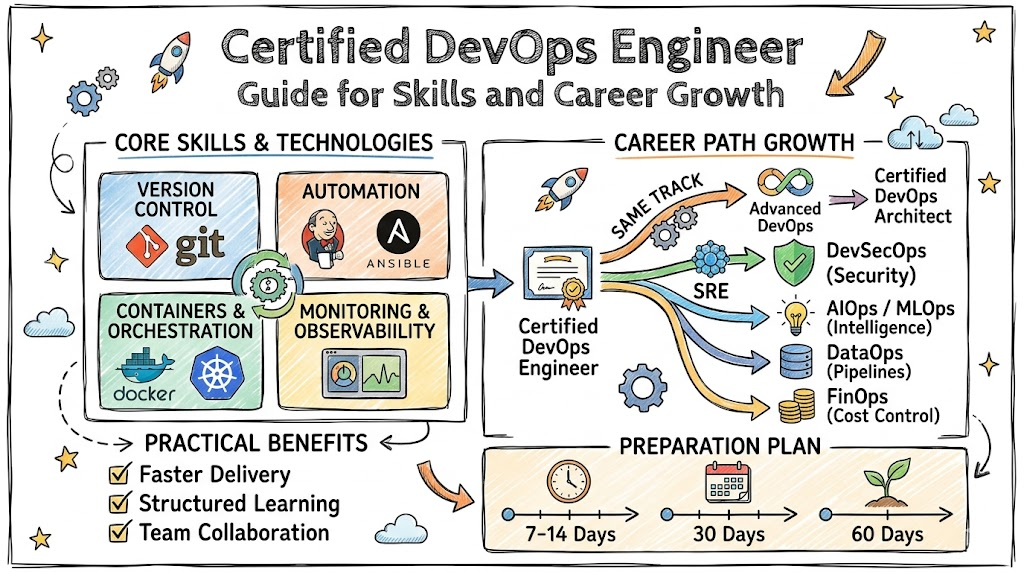
    Modern software teams are under pressure to ship faster, recover faster, and automate more. That is why the Certified DevOps Engineer program matters. The official DevOpsSchool certification page describes it as a 3-hour exam-only program designed to validate expertise in core DevOps practices such as CI/CD pipelines, infrastructure automation, configuration management, and monitoring.

    For working engineers and managers, this certification is useful because it brings structure to a field that often feels too broad. Many professionals know a few tools, but fewer understand how those tools work together across delivery, operations, reliability, and automation. The broader Gurukul Galaxy certification guide also places DevOps in a larger career map that connects with DevSecOps, SRE, AIOps, MLOps, DataOps, and FinOps.

    This guide explains what the certification is, who should take it, what skills it can strengthen, how to prepare, what path to choose next, and how it fits different technical roles.


    Why Certified DevOps Engineer Matters

    DevOps is no longer only about automation scripts or build pipelines. It now touches release speed, cloud operations, platform engineering, collaboration, and service reliability. The official certification page highlights practical areas such as CI/CD, automation, configuration management, containers, orchestration, and monitoring, which shows that this certification is meant for real delivery work rather than only theory.

    This matters for three big reasons. First, it helps professionals build confidence in the full delivery lifecycle. Second, it creates a strong base for more specialized tracks later. Third, it helps managers and senior engineers understand how to improve delivery quality, automation, and team coordination. The reference guide from Gurukul Galaxy reinforces that DevOps sits at the center of several adjacent career paths for software engineers.


    Certification Overview

    CertificationProviderTrackLevelWho it’s forPrerequisitesSkills coveredRecommended order
    Certified DevOps EngineerDevOpsSchoolDevOpsEngineerDevOps Engineers, Cloud Engineers, SREs, Software Engineers, Platform Engineers, Engineering ManagersBasic DevOps understanding and hands-on exposure help; the official page also references Master in DevOps Engineering as a pathwayCI/CD, infrastructure automation, configuration management, monitoring, Jenkins, Docker, Kubernetes, Git, AnsibleStrong starting point for the DevOps track

    The official page states that the exam is online and proctored, and it highlights tools and topics such as Jenkins, Docker, Kubernetes, Git, and Ansible.


    What It Is

    Certified DevOps Engineer is a professional certification for people who want to validate that they can work with real DevOps practices, not just talk about them. It is designed around core delivery and operations skills such as building CI/CD workflows, automating environments, improving configuration consistency, and understanding monitoring across systems.

    It is best seen as a practical career certification for engineers who want stronger DevOps credibility in real project environments.


    Who Should Take It

    This certification is a good fit for professionals such as:

    • DevOps Engineers
    • Software Engineers
    • Site Reliability Engineers
    • Cloud Engineers
    • Platform Engineers
    • Build and Release Engineers
    • System Administrators moving into automation
    • Engineering Managers who want stronger delivery understanding

    The official page specifically identifies DevOps Engineers, Cloud Engineers, and Site Reliability Engineers among the intended audience.


    Skills You’ll Gain

    • Better understanding of DevOps principles and delivery flow
    • CI/CD pipeline thinking
    • Version control workflow using Git
    • Automation mindset for infrastructure and release work
    • Docker-based container basics
    • Kubernetes deployment awareness
    • Configuration management exposure
    • Monitoring and operational visibility basics
    • Collaboration across development and operations
    • Stronger problem solving across software delivery stages

    These skill areas align with the certification page’s focus on CI/CD, automation, configuration management, monitoring, and common DevOps tools.


    Real-World Projects You Should Be Able to Do After It

    • Build a basic CI/CD pipeline for an application
    • Automate build, test, and deployment stages
    • Use Git in a structured release workflow
    • Containerize an application with Docker
    • Support Kubernetes-based deployment flow
    • Apply basic configuration management practices
    • Improve consistency across environments
    • Set up basic monitoring and feedback awareness
    • Reduce manual steps in software delivery
    • Support collaboration between development and operations teams

    These project outcomes are a practical extension of the areas the official certification says it assesses.


    Preparation Plan

    7–14 Days Plan

    This works best for professionals who already have some DevOps exposure.

    Spend the first few days revising DevOps fundamentals, SDLC, release flow, and CI/CD concepts. After that, focus on Git, Jenkins, Docker, Kubernetes, and Ansible basics. In the final days, review automation use cases, configuration management, monitoring concepts, and scenario-style questions. Since the official certification emphasizes practical DevOps areas, this short plan only works well if you already have hands-on familiarity.

    30 Days Plan

    This is the most balanced plan for working professionals.

    Use week one for DevOps fundamentals and lifecycle understanding. Use week two for Git, Jenkins, and CI/CD pipelines. Use week three for Docker, Kubernetes, Ansible, and configuration management. Use week four for monitoring, weak topics, mock practice, and revision. This approach matches the broad skill mix shown on the official page.

    60 Days Plan

    This is the safest option for beginners or career switchers.

    Start with Linux basics, networking awareness, SDLC, and DevOps foundations. Then move to Git, Jenkins, and delivery automation. After that, spend time on Docker, Kubernetes, and configuration management. Use the final stretch for monitoring, revision, hands-on practice, and mock exams. Since DevOpsSchool presents the certification as practical and skill-based, longer preparation is often better for those with less field experience.


    Common Mistakes

    • Learning tools separately but not understanding the full delivery flow
    • Memorizing concepts without practicing real scenarios
    • Ignoring CI/CD basics and jumping too fast into advanced tools
    • Studying Kubernetes without understanding release automation
    • Skipping configuration management
    • Overlooking monitoring and feedback loops
    • Focusing only on theory and not enough on implementation
    • Trying advanced cross-track certifications too early

    The official page’s emphasis on implementation skills makes these mistakes especially costly.


    Best Next Certification After This

    The best next certification depends on your goal.

    If you want to stay on the same path, go deeper into a more advanced DevOps certification. If you want specialization, move toward DevSecOps or SRE. If your role is becoming broader, move toward architect or manager-oriented certifications. The Gurukul Galaxy guide lists adjacent options such as DevOps, DevSecOps, SRE, MLOps, AIOps, DataOps, FinOps, cloud, and platform-oriented certifications, which supports this branching path.


    Choose Your Path

    DevOps Path

    Choose this if you want to become stronger in automation, CI/CD, release engineering, container delivery, and modern platform workflows. This is the most direct continuation after Certified DevOps Engineer. The Gurukul Galaxy guide presents DevOps as a core track for software engineers pursuing delivery-focused growth.

    DevSecOps Path

    Choose this if you want to blend DevOps with security, compliance, and secure-by-default delivery practices. This is a strong next move for engineers working in regulated or security-heavy environments. The reference guide includes DevSecOps as a related certification direction.

    SRE Path

    Choose this if you care most about uptime, SLAs, SLOs, incident response, observability, and production reliability. The official CDE audience already includes SRE-oriented professionals, so this path is a natural extension.

    AIOps/MLOps Path

    Choose this if your team is growing into intelligent operations, event correlation, ML lifecycle management, or automation at scale. Gurukul Galaxy lists both AIOps and MLOps certifications among the broader software engineering paths.

    DataOps Path

    Choose this if your work is moving closer to data pipelines, analytics delivery, orchestration, and quality-driven platform operations. DataOps is also included in the reference certification landscape.

    FinOps Path

    Choose this if your responsibilities increasingly involve cloud efficiency, cost control, governance, and business-aware engineering. FinOps appears in the broader certification ecosystem in the Gurukul Galaxy guide.


    Role → Recommended Certifications

    RoleRecommended certifications
    DevOps EngineerCertified DevOps Engineer → advanced DevOps certification → DevOps Architect
    SRECertified DevOps Engineer → SRE-focused certification
    Platform EngineerCertified DevOps Engineer → Kubernetes / platform / architect path
    Cloud EngineerCertified DevOps Engineer → cloud DevOps or cloud architect path
    Security EngineerCertified DevOps Engineer → DevSecOps certification
    Data EngineerCertified DevOps Engineer → DataOps certification
    FinOps PractitionerCertified DevOps Engineer → FinOps certification
    Engineering ManagerCertified DevOps Engineer → leadership or architect-oriented certification

    This mapping is based on the broader multi-track certification paths described in the Gurukul Galaxy guide.


    Next Certifications to Take

    Same Track

    A more advanced DevOps certification is the best same-track step because it deepens your understanding of automation, platform design, and end-to-end delivery maturity. Gurukul Galaxy places multiple DevOps-related certifications in the software engineering roadmap.

    Cross-Track

    A DevSecOps or SRE certification is the strongest cross-track move. Choose DevSecOps if security is becoming central in your work. Choose SRE if production reliability and operations excellence matter more. Both directions are consistent with the reference guide’s broader certification map.

    Leadership

    A DevOps architect or manager-oriented certification is the right leadership step when you are moving into platform strategy, delivery governance, or team guidance. The certification landscape in the reference article supports this kind of progression.


    Top Institutions Which Help in Training cum Certifications for Certified DevOps Engineer

    DevOpsSchool

    DevOpsSchool is the direct provider of the Certified DevOps Engineer program. Its certification page presents the program as an exam-focused validation of core DevOps skills and also highlights the supporting training ecosystem around it. That makes it the most directly aligned option for structured preparation.

    Cotocus

    Cotocus is commonly associated with enterprise technology consulting and practical implementation-oriented learning support in the wider DevOps ecosystem. For learners who want applied thinking and business context, it can be a useful supporting name in the training space. This is an inference based on its repeated association with the broader ecosystem around DevOpsSchool content.

    ScmGalaxy

    ScmGalaxy is widely known for technical learning resources, tutorials, and professional guidance for engineers. It is often useful for learners who want supporting material, topic reinforcement, and broader software engineering exposure. This is an inference based on its frequent inclusion across the related training and certification ecosystem.

    BestDevOps

    BestDevOps appears regularly in the larger training and certification space connected to DevOps and related disciplines. It is generally relevant for professionals looking for practical training support and structured skill-building. This is also an inference from its repeated presence in the related ecosystem sources.

    devsecopsschool.com

    This is a strong option for professionals who want to continue from DevOps into secure pipeline design, compliance-focused automation, and security integration in delivery workflows. The reference certification landscape includes DevSecOps as a natural adjacent path.

    sreschool.com

    This is useful for engineers planning to grow into reliability, observability, incident response, and service performance work. Since the official CDE page already names SREs in its target audience, this is a logical next learning direction.

    aiopsschool.com

    This is relevant for professionals moving toward intelligent automation, analytics-driven operations, and modern operational decision support. Gurukul Galaxy includes AIOps in the broader certification list for software engineers.

    dataopsschool.com

    This is a useful direction for those working with data pipelines, orchestration, and operational reliability for data workflows. DataOps also appears in the wider certification set from the reference guide.

    finopsschool.com

    This is helpful for engineers and managers who want to connect cloud delivery with cost awareness, optimization, and governance. FinOps is also included in the broader software engineering certification view.


    FAQs on Certified DevOps Engineer

    1. Is Certified DevOps Engineer difficult?

    It is moderately challenging. Professionals with some exposure to CI/CD, Git, Docker, Jenkins, or cloud delivery will find it easier. Beginners can still do well, but they usually need a longer study plan and more practice. The official page makes it clear that the certification covers practical DevOps skills, which is why hands-on comfort matters.

    2. How much time do I need to prepare?

    Preparation time depends on your background. Experienced engineers may be ready with focused revision in 1 to 2 weeks, while most working professionals do better with 30 days. Career switchers often benefit from a 60-day plan. This is a practical recommendation based on the skill areas listed on the official certification page.

    3. Are there prerequisites for this certification?

    There is no sign in the official snippet that you need an advanced formal credential first, but basic knowledge of DevOps concepts, delivery workflows, Linux, automation, and cloud environments is helpful. The official page also references Master in DevOps Engineering as part of its learning ecosystem.

    4. Is this certification valuable for software engineers?

    Yes. It helps software engineers understand how code moves from development to testing, release, deployment, and monitoring. That makes them stronger contributors in modern engineering teams where delivery speed and reliability matter.

    5. What career outcomes can follow after this certification?

    It can support growth toward roles such as DevOps Engineer, Cloud Engineer, Platform Engineer, SRE, and automation-focused engineering roles. The larger certification map from Gurukul Galaxy also shows paths into DevSecOps, AIOps, MLOps, DataOps, and FinOps.

    6. Should I learn DevOps before DevSecOps or SRE?

    Yes. DevOps is the stronger base for most professionals. Once you understand delivery pipelines, automation, monitoring, and operational flow, it becomes easier to move into security-heavy or reliability-heavy specializations. The broader certification guide supports this layered progression.

    7. Is hands-on practice important for this certification?

    Yes. This is one of the most important parts. The official page describes the certification as validating practical expertise in CI/CD, automation, configuration management, and monitoring, so hands-on exposure helps far more than theory alone.

    8. What should I do after completing Certified DevOps Engineer?

    Choose your next step based on your role. Stay in DevOps for deeper automation and architecture, move into DevSecOps for secure delivery, move into SRE for reliability, or explore AIOps, MLOps, DataOps, or FinOps for specialization. That branching approach closely matches the wider certification roadmap in the Gurukul Galaxy guide.


    Conclusion

    Certified DevOps Engineer is a strong foundation certification for professionals who want to become more effective in modern software delivery. It brings together the core parts of DevOps that matter in real teams, including CI/CD, automation, configuration management, containers, orchestration, and monitoring. It is valuable not only for DevOps Engineers, but also for software engineers, SREs, cloud professionals, platform teams, and managers who need a clearer view of delivery systems. The biggest strength of this certification is that it does not lock you into one career direction. It gives you a practical base from which you can grow into DevOps depth, security, reliability, AI-driven operations, data platforms, or cloud cost governance.