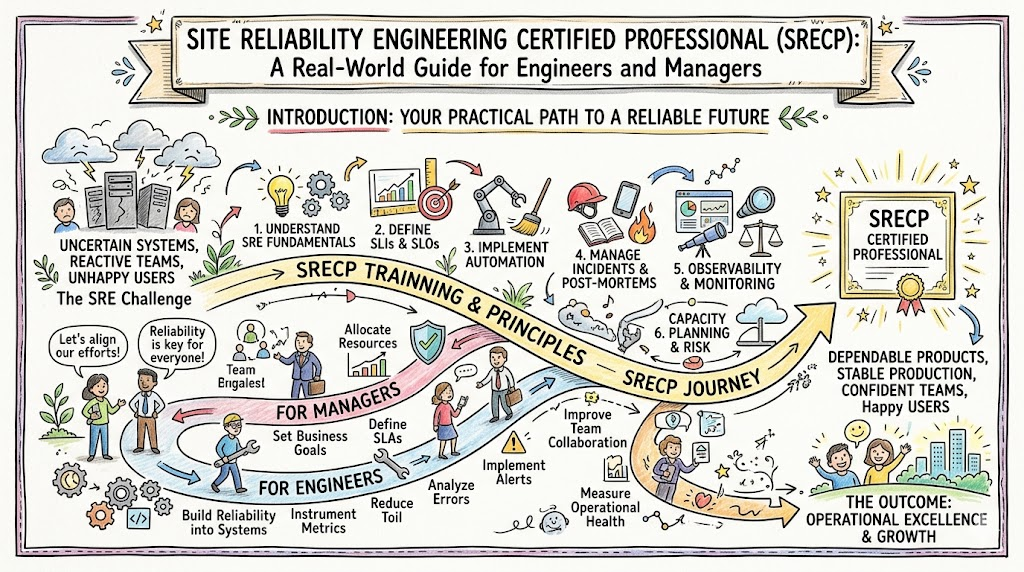
Introduction
Software has become the backbone of almost every business. Whether it is banking, healthcare, retail, education, telecom, media, or SaaS, users expect systems to work all the time. They expect fast response, smooth transactions, secure access, and stable performance. They do not think about servers, pipelines, containers, or cloud architecture. They only care whether the service works.
That simple expectation creates a serious challenge for engineering teams.
Modern applications are not small or simple anymore. They run across cloud infrastructure, container platforms, APIs, distributed services, databases, CI/CD pipelines, and observability systems. Teams release changes faster than before. Environments scale quickly. Dependencies are deeper. A single failure can travel across services and affect thousands or even millions of users.
This is why reliability is no longer only an operations problem. It is an engineering responsibility.
Site Reliability Engineering, usually called SRE, gives teams a practical way to manage this challenge. It helps them think clearly about uptime, performance, resilience, incident response, alert quality, automation, and service goals. Instead of relying only on manual support and reactive fixes, SRE creates a more disciplined way of running production systems.
For working engineers, SRE brings structure to the way systems are built and supported.
For managers, SRE creates a better language for discussing service quality, risk, platform maturity, and business impact.
The Site Reliability Engineering Certified Professional, or SRECP, is designed for professionals who want to learn this discipline in a structured and practical way. It is useful for people who want more than general DevOps or operations awareness. It helps them understand how reliability is measured, improved, and managed in real environments.
This guide explains the SRECP certification from a practical career point of view. It covers what the certification means, why it matters, why certifications are valuable, why DevOpsSchool is a strong option, what skills you gain, who should take it, how to prepare, what learning path to choose, and what to do next after completing it.
What is Site Reliability Engineering Certified Professional (SRECP)?
Site Reliability Engineering Certified Professional is a professional certification for people who want to build strong skills in modern reliability engineering. It is designed to help learners understand how reliable systems are created, operated, measured, and improved in production environments.
In simple terms, SRECP teaches you how to support software systems in a smarter and more measurable way.
That is important because many professionals already do work related to reliability without using a complete reliability framework. A DevOps engineer may work on automation and deployment. A cloud engineer may focus on uptime and infrastructure. A platform engineer may manage shared services. A system administrator may handle incident support. A manager may track escalations and service quality. All of them touch reliability, but often in separate pieces.
SRECP helps bring these pieces together.
It teaches professionals to think beyond tasks and tools. Instead of only asking, “How do I fix this issue?” they begin asking better questions:
What level of service should users expect?
How do we measure whether the service is healthy?
How much risk can we take when releasing changes?
Which operational work should be automated?
How do we reduce repeated failures?
How do we respond to incidents without creating more chaos?
That shift is what makes this certification valuable. It helps people move from general production support into a more mature reliability mindset.
Official certification link: https://www.devopsschool.com/certification/sre-certified-professional-srecp.html
Why it Matters in Today’s Software, Cloud, and Automation Ecosystem
Today’s software ecosystem is fast, distributed, and always changing. Applications now depend on cloud services, infrastructure as code, container orchestration, monitoring tools, service meshes, CI/CD pipelines, and many other moving parts. This gives teams speed and flexibility, but it also creates complexity.
When complexity rises, failures become harder to predict.
A small bug may trigger latency. A weak deployment process may create downtime. Poor monitoring may hide a real issue until customers complain. Noisy alerting may exhaust teams. A missing service objective may create confusion about what “good enough” really means. Manual operational work may slow down response and increase human error.
This is why SRE matters.
SRE provides a practical model for handling reliability in modern systems. It helps teams balance speed and stability. It helps them define useful service expectations. It encourages automation over repetitive toil. It improves incident handling. It creates better observability. Most importantly, it teaches teams to manage reliability intentionally instead of hoping that things stay stable.
This has clear value for both engineers and managers.
For engineers, SRE makes day-to-day technical work more meaningful. It connects monitoring, automation, deployment safety, and platform operations to real service outcomes.
For managers, SRE creates a framework for conversations around uptime, support load, operational maturity, customer experience, and engineering effectiveness.
In short, SRE matters because businesses can no longer treat reliability as an afterthought. Reliability is now part of product quality, customer trust, and business continuity.
Why Certifications are Important for Engineers and Managers
A certification does not replace real work, but it can make real work more structured and more valuable.
Many professionals learn from daily experience. That is a good thing. However, experience can sometimes be incomplete. Someone may become very strong in one tool or process while still missing the larger reliability picture. Another person may be good at firefighting but weak in prevention. Another may understand infrastructure but not know how to define service quality.
Certification helps solve that problem by creating an organized learning path.
For engineers, certification offers several benefits.
It gives direction. Instead of studying random topics, professionals can follow a clear progression.
It builds confidence. Many engineers already do part of the work, but a certification helps them see how those parts fit into a complete system.
It supports career visibility. A role-relevant certification can make growth easier to explain to employers and hiring teams.
It also helps fill gaps. An engineer who understands dashboards but not service objectives can improve that weakness. An engineer who knows deployment automation but not incident discipline can close that gap too.
For managers, certification offers a different type of value.
Managers need shared language. They need to understand how reliability should be measured, how operational risk should be discussed, and how teams can mature over time. They also need a better way to support hiring, mentoring, and capability building.
A strong certification helps both engineers and managers develop a more complete understanding of modern system reliability. It does not create mastery on its own, but it gives structure to learning and makes future growth more focused.
Why Choose DevOpsSchool?
DevOpsSchool is widely known for role-focused technical learning. That matters because people pursuing SRECP are usually not complete beginners. They are often working engineers, technical leads, architects, operations professionals, or managers who want practical learning that matches real engineering environments.
Another strength is that the learning style is generally aligned with real job needs. A good SRE certification should not feel isolated from cloud operations, CI/CD, observability, automation, incidents, and service support. It should feel connected to actual work. That is where DevOpsSchool becomes useful for many learners.
It is also a suitable choice for mixed audiences. Some learners need strong technical understanding. Others need enough depth to guide teams and make better operational decisions. A provider that can support both groups adds real value.
For professionals who want a reliability certification with career relevance, practical direction, and a modern engineering focus, DevOpsSchool is a meaningful option.
Certification Deep-Dive: Site Reliability Engineering Certified Professional (SRECP)
What is this certification?
SRECP is a professional certification that helps learners understand how reliability should be approached in modern software systems. It brings together engineering thinking, operational discipline, observability awareness, automation habits, and service-level understanding.
It is not just about keeping systems alive.
It is about learning how to make services dependable, measurable, supportable, and scalable in the real world.
This certification helps learners understand not just how to respond to problems, but how to build systems and practices that reduce problems over time.
Who should take this certification?
This certification is useful for a broad range of professionals.
It is a strong option for DevOps engineers who want deeper production and reliability knowledge.
It is a natural fit for SRE aspirants who want a structured learning path.
It is valuable for platform engineers responsible for internal systems, uptime, and service operations.
It helps cloud engineers who manage performance, availability, and support readiness.
It can also support operations professionals who want to move from manual support work into more engineering-led operations.
Engineering managers can benefit too, especially if they are responsible for service quality, incident readiness, escalation flow, and operational maturity.
Even software engineers can gain value from this certification when they work closely with production environments and care about system behavior after deployment.
Certification Overview Table
| Certification Name | Track | Level | Who it’s for | Prerequisites | Skills covered | Recommended order | Link |
|---|---|---|---|---|---|---|---|
| Site Reliability Engineering Certified Professional (SRECP) | SRE | Professional | DevOps engineers, SRE aspirants, platform engineers, cloud engineers, operations professionals, engineering managers | Basic knowledge of Linux, cloud, monitoring, CI/CD, and production environments is helpful | Reliability engineering, observability, incident handling, service objectives, automation, operational maturity, production stability | A strong starting point for the SRE track | https://www.devopsschool.com/certification/sre-certified-professional-srecp.html |
Site Reliability Engineering Certified Professional (SRECP)
What it is
SRECP is a structured certification path for professionals who want to build serious capability in service reliability and production operations. It teaches how reliability is defined, supported, observed, and improved in modern engineering environments.
It is useful for people who want to move from reactive operations into reliability-driven engineering.
Who should take it
- DevOps engineers
- SRE aspirants
- Platform engineers
- Cloud engineers
- Operations professionals
- System administrators
- Technical leads
- Engineering managers
- Software engineers who work near production systems
Skills you’ll gain
- Clear understanding of Site Reliability Engineering principles
- Better thinking around service quality and service expectations
- Ability to understand and use service-level concepts
- Improved incident response mindset
- Stronger observability awareness
- Better alerting judgment
- Stronger automation-first thinking
- Better understanding of operational toil and how to reduce it
- Improved production support maturity
- Better alignment between technical work and customer impact
Real-world projects you should be able to do after it
- Define service reliability goals for an application
- Create basic health dashboards for services or platforms
- Improve alert quality so teams focus on real problems
- Support a simple incident response workflow
- Review repeated support pain points and identify automation opportunities
- Improve production readiness before deployments
- Build better visibility into system health and performance
- Introduce reliability discussions into release planning
- Help platform teams improve operational discipline
- Contribute to service-improvement initiatives in production
Preparation plan
7–14 days
This preparation plan is best for professionals who already work in DevOps, cloud, operations, or platform roles. In this short window, focus on targeted revision. Review reliability basics, incident concepts, service objectives, observability, alerting, and automation. This path works only if you already have practical industry exposure.
30 days
This is the most balanced plan for working professionals. Spend the first part building conceptual clarity. Use the second part to connect theory with real production scenarios. Use the final phase for revision, practice notes, and practical case understanding. This approach helps build real understanding instead of surface-level memorization.
60 days
This plan is best for beginners or professionals changing roles. Start with Linux, cloud fundamentals, monitoring basics, CI/CD, containers, and production support. Then move into SRE concepts, service quality thinking, incidents, observability, and automation. Finish with mini-projects, review, and deeper topic revision.
Common mistakes
- Thinking SRE is only about monitoring
- Learning tools without understanding why they matter
- Ignoring service-level concepts
- Focusing only on incident response and not prevention
- Studying theory without practical use cases
- Treating automation as optional
- Preparing without linking topics to real production environments
- Forgetting the business value of reliability
Best next certification after this
The next certification depends on your direction.
If you want to stay close to the same domain, an observability-focused certification is a smart next step.
If you want stronger cloud-native infrastructure depth, a Kubernetes-related certification is a strong choice.
If you want broader delivery or leadership ownership, a DevOps or management-focused certification makes sense.
Choose your path
DevOps
This path is ideal for professionals focused on delivery pipelines, automation, infrastructure, and release systems. SRECP adds reliability depth and helps DevOps professionals think beyond deployment into long-term service health.
DevSecOps
This path is useful for learners working in secure delivery environments. SRECP strengthens this direction by adding resilience, operational discipline, and better incident readiness to security-focused work.
SRE
This is the most direct and natural path for professionals who want to build careers in service reliability, observability, operational improvement, and incident management. SRECP is a strong foundation for this path.
AIOps/MLOps
This path suits professionals working with intelligent automation, machine learning platforms, or AI-supported operations. SRECP gives them the reliability discipline needed for complex, automated environments.
DataOps
Data systems also need reliable workflows, stable pipelines, and strong operational visibility. SRECP helps DataOps professionals bring service-quality thinking into data platform work.
FinOps
FinOps focuses on financial efficiency in cloud environments. Reliability supports this goal because unstable systems often create waste, repeated rework, emergency fixes, and poor resource usage. SRECP can therefore complement a FinOps learning path very well.
Role → Recommended certifications mapping
| Role | Recommended certifications |
|---|---|
| DevOps Engineer | SRECP, DevOps-focused certifications, Kubernetes-related certifications |
| SRE | SRECP first, then observability and advanced reliability certifications |
| Platform Engineer | SRECP plus Kubernetes, Terraform, and platform engineering learning |
| Cloud Engineer | SRECP plus cloud operations or architecture certifications |
| Security Engineer | DevSecOps certifications first, then SRECP for resilience and production depth |
| Data Engineer | DataOps learning plus SRECP for operational reliability |
| FinOps Practitioner | FinOps learning plus SRECP for stability and efficiency alignment |
| Engineering Manager | SRECP plus leadership-focused DevOps, SRE, or platform strategy certifications |
Next certifications to take
Same track
An observability-focused certification is one of the best next moves after SRECP. Once you understand reliability concepts, stronger skills in metrics, logs, traces, dashboards, and telemetry design can make your practice much deeper.
Cross-track
A Kubernetes-related certification is a strong cross-track option. Many real production environments now rely on container orchestration, so deeper Kubernetes knowledge can make your reliability skills more practical.
Leadership
A DevOps or engineering-management-oriented certification is a good leadership path after SRECP. It is especially useful for professionals who want to move from individual execution into platform ownership, cross-team strategy, and operational governance.
List of top institutions which provide help in training cum certifications for Site Reliability Engineering Certified Professional (SRECP)
DevOpsSchool
DevOpsSchool is the direct provider of the SRECP certification, so it is the most aligned option for learners who want official training support for this program. It is suitable for working professionals who want practical learning, structured guidance, and a certification path connected to real engineering work.
Cotocus
Cotocus can be useful for professionals looking for implementation-focused technical support and training. Learners who want stronger practical exposure around cloud, automation, and engineering workflows may find it helpful while building reliability-related skills.
Scmgalaxy
Scmgalaxy is known for technical learning in DevOps, automation, and engineering tools. It can be a helpful option for people who want to strengthen their fundamentals before moving deeper into specialized reliability areas.
BestDevOps
BestDevOps is often recognized in the wider DevOps and cloud training ecosystem. It can support professionals who want structured learning across automation, infrastructure, and engineering disciplines that connect well with SRE growth.
devsecopsschool.com
This platform can be valuable for professionals who want to combine reliability thinking with secure delivery practices. It is especially useful for environments where resilience and security need to support each other.
sreschool.com
SRESchool is naturally relevant for professionals who want a stronger and more focused path in reliability engineering. It can support learning in observability, service health, incident handling, and operational maturity.
aiopsschool.com
AIOpsSchool can be useful for learners interested in intelligent operations, analytics-based automation, and the future direction of operational engineering. It complements SRE well for advanced operations paths.
dataopsschool.com
DataOpsSchool is helpful for learners working on data platforms, data pipelines, and analytics systems. It can support professionals who want better reliability and operational consistency in data-driven environments.
finopsschool.com
FinOpsSchool is relevant for professionals focused on cloud cost control, optimization, and governance. Since stable systems often support better efficiency, it can be a useful complementary learning area for SRE-focused professionals.
FAQs
1. Is SRECP a beginner-level certification?
It is better understood as a professional-level certification. Beginners can still take it, but they should allow more study time and strengthen their foundations first.
2. How difficult is SRECP?
It is moderate to challenging depending on your background. Professionals already working with cloud, DevOps, monitoring, or production support usually find it easier.
3. How much preparation time is usually enough?
For many working professionals, 30 days is a practical target. Experienced engineers may need less time. Beginners may need closer to 60 days.
4. Do I need prior operations experience?
It helps, but it is not the only valid path. DevOps, cloud engineering, platform work, system administration, and backend engineering can all support SRE learning.
5. Is SRECP useful for software engineers?
Yes. Software engineers who work closely with production systems, APIs, cloud deployments, or backend services can gain strong value from it.
6. Is it only for people with the SRE job title?
No. It is highly useful across DevOps, platform engineering, cloud operations, technical support, and management roles.
7. Will it help with career growth?
Yes. It can strengthen your profile for reliability-focused roles and improve your readiness for production ownership responsibilities.
8. Is this certification useful for managers?
Yes. Managers benefit because it gives them a clearer way to think about service quality, operational risk, and team maturity.
9. What should I study before starting?
Linux basics, cloud fundamentals, monitoring, containers, CI/CD, and production support concepts are all helpful starting points.
10. Is SRECP only about monitoring and alerting?
No. Monitoring is only one part. The certification also relates to service quality, incident discipline, automation, service objectives, and operational improvement.
11. Should I take Kubernetes certification before SRECP?
That depends on your role. If your work is more reliability-focused, SRECP is a strong first step. If you work deeply with Kubernetes every day, both paths can complement each other well.
12. Will SRECP help in real-world projects?
Yes. Its real value grows when you apply it to dashboards, alerting, incidents, automation, and service improvement work in production.
FAQs on Site Reliability Engineering Certified Professional (SRECP)
1. What does SRECP stand for?
It stands for Site Reliability Engineering Certified Professional.
2. What is the main goal of this certification?
Its main goal is to help professionals understand and apply reliability engineering practices in modern production systems.
3. Is SRECP good for DevOps engineers?
Yes. It is one of the best next steps for DevOps professionals who want stronger production and reliability skills.
4. Can managers benefit from SRECP?
Yes. It helps managers better understand service health, reliability goals, incident readiness, and operational maturity.
5. Is SRECP relevant in cloud-native environments?
Yes. Cloud-native systems are exactly the kind of environments where structured reliability practices matter most.
6. What makes it different from general operations learning?
It focuses on engineering-led reliability instead of only manual support and reactive troubleshooting.
7. Is SRECP useful for platform engineers?
Yes. It can help platform engineers improve service stability, operational quality, and production discipline.
8. What is the biggest value of SRECP?
Its biggest value is that it turns scattered operational knowledge into a more complete and practical reliability mindset.
Conclusion
The Site Reliability Engineering Certified Professional certification is a strong and practical choice for professionals who want to grow in modern reliability engineering. It does not stay limited to one tool, one cloud platform, or one narrow support activity. Instead, it helps learners understand how service quality, observability, incidents, automation, and production stability connect in real engineering environments. That makes it useful for DevOps engineers, SRE aspirants, cloud professionals, platform teams, software engineers, and engineering managers. In a world where users expect systems to be available, fast, and dependable all the time, reliability has become one of the most valuable strengths a professional can build. SRECP offers a structured path to develop that strength in a practical and career-relevant way.
#SRECP, #SiteReliabilityEngineering, #SRECertification, #DevOpsCareer, #CloudReliability,