Introduction
Every mobile network needs a reliable way to identify itself. Mobile operators serve different countries, manage network services, and connect subscribers through complex telecom systems. Network identification codes help these systems distinguish one mobile network from another.
Three important terms appear throughout this process: MCC, MNC, and PLMN. These identifiers help telecom professionals organize network information and understand how mobile networks identify themselves. They also support research into operator directories, roaming, and eSIM connectivity.
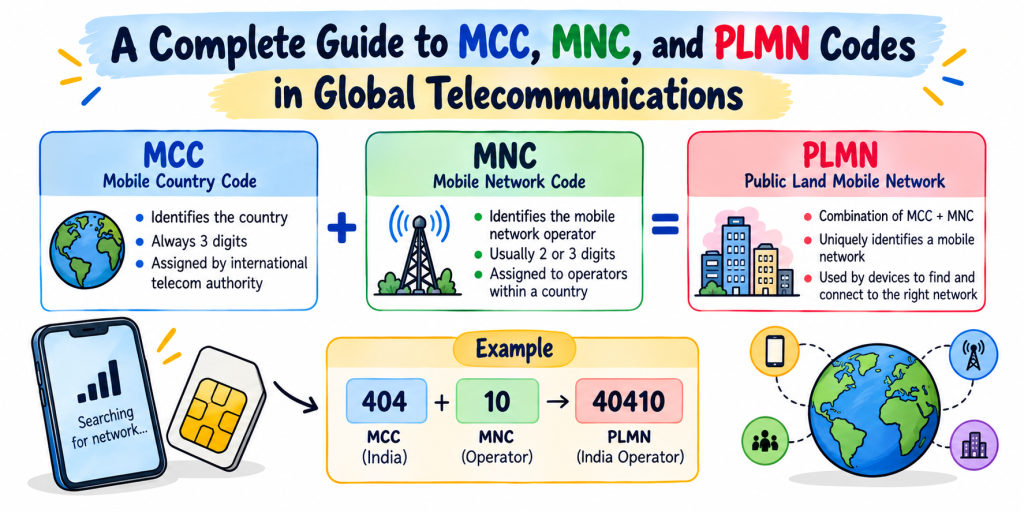
Although these terms often appear together, they serve different purposes. The MCC identifies a country or geographical numbering area. The MNC identifies a network within that context. The PLMN represents the resulting mobile network identity.
Understanding these differences can help developers, telecom analysts, researchers, and travelers interpret network information more accurately. It can also reduce errors when people build operator databases or investigate mobile connectivity.
This guide explores the meaning of each identifier, explains their relationship, and examines their practical uses. It also covers data verification, common mistakes, and the role of eSIMGlobo in global telecom research.
Why Mobile Networks Need Identification Codes
Mobile networks operate within a structured telecommunications environment. A country may have several mobile operators, and each operator may offer different services or brands.
Names alone cannot always provide the precision that technical systems require. Companies may use different consumer brands, while some service providers rely on another operator’s network infrastructure.
Network identifiers help systems distinguish these networks. They also give researchers a consistent way to organize information across countries and operators.
Telecom identification codes can support several activities:
- Organizing mobile network operator directories.
- Researching country-specific network assignments.
- Understanding network information on mobile devices.
- Investigating international roaming arrangements.
- Supporting telecom data analysis.
- Researching networks associated with eSIM services.
- Developing applications that display operator information.
These codes provide a technical foundation for identifying networks. However, they do not independently confirm signal strength, coverage, roaming access, or service availability.
MCC: The Country Identification Component
MCC stands for Mobile Country Code. This identifier uses three digits to represent the country or geographical numbering area associated with a mobile network assignment.
The MCC provides the first layer of context when someone examines a mobile network identity. It helps distinguish assignments associated with different countries or numbering areas.
How MCC Works
Imagine a telecom database that contains records from several countries. The database needs a consistent way to group those records by their assigned country context.
The MCC helps provide that structure. A researcher can examine the code and investigate the country or geographical area associated with the assignment.
However, an MCC does not identify one specific mobile operator. Several operators within the same country can share the same MCC.
What MCC Cannot Tell You
An MCC does not provide a complete description of a mobile network. It does not identify every service the operator offers, and it cannot confirm that the operator provides coverage in a particular location.
It also does not necessarily reveal a user’s physical location. A subscriber may connect to a network outside their home country while roaming.
Researchers should therefore treat the MCC as one part of a larger network identity, not as a complete answer to every telecom question.
MNC: The Network Identification Component
MNC stands for Mobile Network Code. It identifies a mobile network within the relevant MCC context.
The MNC adds detail that the MCC alone cannot provide. While the MCC supplies the country or geographical context, the MNC helps distinguish a network within that context.
Understanding MNC Length
An MNC may contain two or three digits, depending on the applicable numbering plan.
This difference matters when people store or process network records. Software that assumes every MNC contains exactly two digits may mishandle valid values.
Researchers should preserve the original identifier format. They should also avoid removing leading zeros during data imports or database conversions.
Why MNC Needs an MCC
An MNC should not be treated as a globally unique identifier on its own. The same MNC value can appear in different MCC contexts.
For example, a database might contain the same MNC value in records associated with two different countries. Those records do not necessarily identify the same network.
Combining the MCC and MNC provides the context needed to distinguish the network identity.
What MNC Reveals About an Operator
An MNC can help researchers investigate network assignments and organize operator records. However, the code alone does not explain every commercial relationship.
A consumer-facing brand, virtual mobile operator, eSIM reseller, and underlying network operator may have different roles. Researchers need additional evidence to understand those relationships.
PLMN: The Complete Network Identity
PLMN stands for Public Land Mobile Network. In network identification contexts, a PLMN identity combines the MCC and MNC.
This combination provides a more specific network identity than either component provides alone.
How PLMN Connects MCC and MNC
The MCC identifies the country or geographical numbering context. The MNC identifies the network within that context.
Together, they form the PLMN identity used to distinguish the associated mobile network.
A telecom database may store the MCC and MNC in separate fields while also displaying their combined identity. This approach helps users examine the individual components without losing the complete network context.
Why PLMN Matters
PLMN information appears in technical discussions about mobile network identification, selection, and registration.
Devices and network systems use relevant network information as part of their operating procedures. The exact process depends on the technology, network configuration, and device.
However, identifying a PLMN does not guarantee that a device can register with that network. Subscription permissions, device compatibility, network policies, and other conditions can affect access.
MCC vs. MNC vs. PLMN: A Side-by-Side Comparison
The following table highlights the main differences between the three terms.
| Feature | MCC | MNC | PLMN |
|---|---|---|---|
| Full form | Mobile Country Code | Mobile Network Code | Public Land Mobile Network |
| Primary role | Identifies the country or geographical numbering context | Identifies a network within the relevant MCC context | Represents a mobile network identity |
| Typical structure | Three digits | Two or three digits, depending on the numbering plan | Combination of MCC and MNC |
| Identifies a specific network alone? | No | Not globally, without MCC context | Provides the combined network identity |
| Common research use | Country-level grouping | Network-level identification | Complete network identification |
| Main limitation | Does not identify an individual operator by itself | Does not provide global uniqueness alone | Does not prove coverage or service access |
The three identifiers work together rather than competing with one another. Each contributes a different level of detail to network identification.
When researchers examine a telecom record, they should check the individual components and their combined meaning.
How Devices Use Mobile Network Information
Mobile devices interact with network identification information during network discovery, selection, and registration. These processes help devices identify available networks and determine how to proceed.
Network Discovery
A device searches for compatible mobile networks within its radio environment. Depending on location and device capabilities, it may detect signals from multiple networks.
The device can obtain network identity information through the relevant mobile network procedures.
Network Selection
The device uses applicable rules and available network information to determine which networks it may select.
The process can depend on the device configuration, subscription, network availability, and other technical conditions. Network identity alone does not determine every selection decision.
Registration
After selecting a suitable network, the device may attempt to register.
The network evaluates the request under its applicable rules. It may reject registration if the subscriber lacks permission or the device does not meet relevant requirements.
Therefore, recognizing a network identity and gaining access to its services are separate matters.
International Roaming
Travelers may connect to networks outside their home operator’s network when roaming arrangements allow it.
During this process, the device may encounter different PLMN identities. The subscriber’s plan, roaming agreements, local network conditions, and operator policies influence which services the device can access.
MCC, MNC, and PLMN information helps identify the networks involved, but it does not establish that a roaming agreement exists.
Practical Applications of MCC, MNC, and PLMN
Network identifiers support several activities across the telecommunications industry. Their usefulness depends on accurate records and a clear understanding of what each code represents.
Mobile Network Operator Research
Researchers often need to identify operators across multiple countries. MCC and MNC values help organize network assignments and distinguish records that might otherwise look similar.
A well-structured directory can also include operator names, country information, and additional network details. Each field still requires suitable evidence.
Telecom Data Management
Companies that manage telecom data need consistent identifiers to compare and organize records.
MCC and MNC fields help group information by country and network. A combined PLMN field can make it easier to search for a specific network identity.
Data teams should preserve the original values and document their sources. These steps reduce confusion when several systems contribute information to one database.
eSIM Service Research
An eSIM uses a digital profile to support mobile connectivity on a compatible device.
People researching eSIM services may want to know which underlying mobile networks a plan can access. Network identifiers can help organize this research.
However, the relationship between an eSIM provider and a mobile network operator requires separate verification. An eSIM seller may rely on another company’s network or on roaming arrangements.
Before choosing a plan, users should check the provider’s terms, supported networks, device requirements, and local service conditions.
Roaming Analysis
Telecom analysts can use network identifiers to investigate which networks appear in roaming-related records.
These codes help identify network identities, but they do not prove that operators have an active commercial agreement. Analysts must consult additional documentation to confirm the relationship.
Telecom Application Development
Developers may use MCC, MNC, and PLMN data in applications that display network information.
For example, an application might use a combined network identity to retrieve an operator record from a database.
Developers should account for different MNC lengths, missing fields, and conflicting records. They should also avoid presenting a network assignment as proof of live coverage or service availability.
A Reliable Process for Checking Network Identifiers
A structured lookup process can help researchers find errors before they use network data in reports, applications, or business decisions.
Identify the Available Field
Start by checking whether the source provides an MCC, an MNC, or a complete PLMN identity.
Read the field name and supporting documentation. Do not classify a number based only on its length or appearance.
If the source provides an MNC without an MCC, obtain the relevant country context before identifying the network.
Check the MCC Assignment
Investigate the MCC and compare its associated country or geographical numbering context with the record.
If the values conflict, examine the source and its definitions. A country label may describe a commercial market rather than the formal numbering assignment.
Do not change the record without supporting evidence.
Preserve the MNC Format
Check the MNC’s digit length and preserve its original representation.
Store identifiers as text when necessary to protect leading zeros. Avoid automatic conversions that alter the displayed value.
If a source contains an unexpected format, investigate it rather than assuming the data must be correct.
Review the Combined PLMN Identity
Compare the MCC and MNC together with a suitable reference.
Check whether the combined values match the expected network identity. Review the source’s coverage and update date before accepting the result.
If two references disagree, investigate their scope, definitions, and dates.
Confirm the Operator Relationship
Check which organization the record actually describes.
The network operator may differ from the consumer brand, virtual operator, or eSIM seller. Reliable documentation can help clarify these relationships.
Keep these roles separate in your database or report.
Record the Evidence
Save the reference used for the lookup and the date of verification.
This record helps other people review the result later. It also makes it easier to identify entries that need another check.
For important applications, establish a review schedule that matches the business need and the expected rate of change.
Common Data Problems and How to Avoid Them
Network records can contain formatting errors, incomplete fields, or unclear operator relationships. The following table outlines common problems and practical ways to address them.
| Data Problem | Possible Consequence | Recommended Action |
|---|---|---|
| Missing MCC | The MNC may lack the context needed for accurate identification | Find the relevant MCC before interpreting the network |
| Incorrect MNC length | The system may misread or reject the identifier | Check the numbering plan and preserve the original format |
| Lost leading zeros | Data systems may change the displayed value | Store identifiers in suitable text fields |
| Outdated operator details | Reports may rely on information that no longer reflects the source’s scope | Review the source date and relevant documentation |
| Confusion between brands and operators | The database may assign a network to the wrong organization | Verify the role of each organization |
| Unsupported coverage claims | Readers may assume that a valid code guarantees local service | Check separate coverage and availability information |
| Unverified roaming claims | Readers may assume that two networks have a roaming agreement | Confirm the relationship through suitable documentation |
| Conflicting source records | The database may combine incompatible information | Compare definitions, dates, and geographic scope |
A reliable database should flag unresolved conflicts instead of hiding them. This practice helps users understand where the evidence supports a conclusion and where further verification remains necessary.
Best Practices for Managing Telecom Identifier Data
Telecom databases become more useful when they maintain clear rules for storage, validation, and review.
Separate Identification From Operator Descriptions
Store MCC and MNC values in separate fields. Keep the combined PLMN identity available when your data model requires it.
Store operator names, brands, country labels, and service descriptions separately. This structure makes it easier to update one field without changing unrelated information.
Preserve the Original Data
Retain the original identifier format during imports and exports.
Validation rules can flag missing values, unexpected characters, or invalid lengths. However, validation should identify problems rather than silently rewrite values without evidence.
Document Data Sources
Record where each important identifier came from. Include the verification date and any relevant notes about the source’s scope.
This information helps analysts evaluate the record and plan future reviews.
Handle Uncertainty Clearly
If two sources disagree, investigate before choosing one value.
Different sources may cover different periods or describe different relationships. If the evidence does not resolve the issue, mark the record as uncertain.
Clear uncertainty labels are more useful than unsupported confidence.
Avoid Treating Codes as Service Guarantees
Keep network identification data separate from information about live coverage, roaming eligibility, and device compatibility.
This separation prevents users from drawing conclusions that the identifier cannot support.
How eSIMGlobo Fits Into Global Telecom Research
eSIMGlobo is an independent global telecom directory focused on mobile network operators and identifiers such as MCC, MNC, and PLMN.
The directory can support initial research for people who need to explore operator information and understand network identification records. It may also help organize research across different countries and network assignments.
Researchers should still examine the available details carefully. They should check the identifier format, source information, date, and operator relationship when those details matter to their work.
A directory entry should serve as part of the research process, not as automatic proof of coverage, roaming access, or eSIM compatibility.
By combining directory research with appropriate verification, telecom professionals and developers can build a clearer understanding of global mobile network information.
Frequently Asked Questions
1. What is the main purpose of an MCC?
An MCC identifies the country or geographical numbering area associated with a mobile network assignment. It provides context for network identification but does not identify an individual operator on its own.
2. How does an MNC help identify a mobile network?
An MNC distinguishes a mobile network within the relevant MCC context. Researchers generally need both values to interpret the network identity correctly.
3. What information does a PLMN identity contain?
In common network identification contexts, a PLMN identity combines an MCC and an MNC. Together, these values represent a specific mobile network identity.
4. Can an MNC identify a network without an MCC?
An MNC alone may not provide enough information for unique identification across countries. Researchers should use the associated MCC to establish the correct context.
5. Why do some MNCs have different digit lengths?
The applicable numbering plan determines whether an MNC contains two or three digits. Systems should preserve the assigned format instead of assuming that every MNC has the same length.
6. Do MCC and MNC codes show a user’s exact location?
No. These codes help identify a network assignment. They do not independently reveal a user’s exact physical location.
7. Can a PLMN code guarantee that my phone will connect?
No. A network identity does not guarantee successful registration. Device support, subscription permissions, network policies, and local conditions can affect connectivity.
8. How can these identifiers help with eSIM research?
They can help researchers organize information about mobile networks associated with eSIM services. Users must still check plan terms, supported networks, device compatibility, and local availability.
9. What should I do if two databases show different network details?
Compare the sources, dates, definitions, and geographic scope. Do not combine conflicting values until you understand the reason for the difference. If uncertainty remains, flag the record for further review.
10. Where can I research global mobile network identifiers?
You can start with eSIMGlobo, an independent directory for researching mobile network operators and identifiers. For important technical or business decisions, check the available records against suitable supporting documentation.
Final Thoughts
Reliable mobile network research starts with understanding what each identifier represents. MCC provides country or geographical context, MNC distinguishes a network within that context, and PLMN combines the values into a network identity.
These codes help people organize telecom records, investigate network relationships, and research eSIM services. Their value depends on accurate formatting, trustworthy sources, and careful interpretation.
Researchers should also remember that network identification does not prove coverage, roaming access, or device compatibility. Those questions require additional evidence.
With clear data practices and consistent verification, telecom teams can make better use of MCC, MNC, and PLMN information across global network research.
