Introduction
The Master in Observability Engineering (MOE) is a comprehensive professional program designed to bridge the gap between traditional monitoring and modern, high-cardinality telemetry analysis. This guide is crafted for engineers and technical leaders who need to navigate the complexities of distributed systems, microservices, and cloud-native architectures where “standard” metrics are no longer sufficient. By focusing on the three pillars of observability—logs, metrics, and traces—this program empowers professionals to move beyond reactive troubleshooting into proactive system reliability.
As systems grow in complexity, the ability to gain deep insights into internal states from external outputs becomes a critical differentiator for career growth. Whether you are an SRE looking to refine your SLO/SLI strategies or a developer aiming to build more “inspectable” code, this roadmap provides the clarity needed to advance. Through the curriculum offered by DevOpsSchool, professionals gain the hands-on expertise required to implement enterprise-grade observability frameworks that directly impact business uptime and user experience.
What is the Master in Observability Engineering (MOE)?
The Master in Observability Engineering (MOE) represents the pinnacle of modern operational discipline, moving away from simple uptime monitoring toward a holistic understanding of system health. It exists because modern distributed environments generate massive amounts of data that often lack context, leading to “alert fatigue” and delayed incident response. This program is built to teach engineers how to architect systems that are observable by design, rather than treating monitoring as an afterthought or a secondary plugin.
It emphasizes real-world, production-focused learning, focusing on how telemetry data flows through complex pipelines from generation to visualization. Instead of just learning how to use a specific tool, the MOE focuses on the underlying principles of telemetry engineering, data sampling, and structured logging. This aligns perfectly with modern engineering workflows where DevOps and SRE teams must collaborate to ensure that every deployment is measurable and every failure is traceable back to its root cause.
Who Should Pursue Master in Observability Engineering (MOE)?
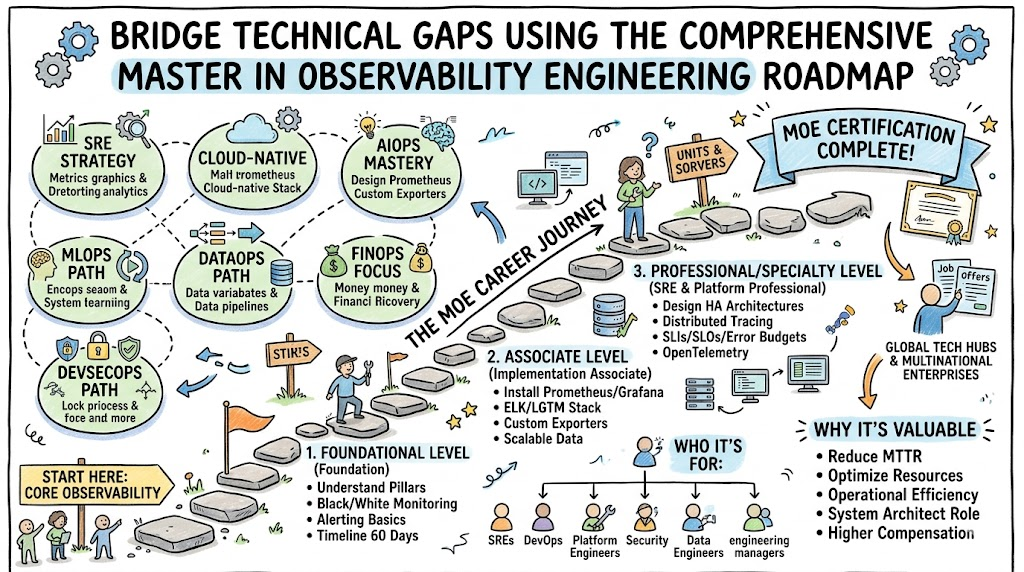
This certification is highly beneficial for a wide range of technical roles, particularly those involved in maintaining high-availability systems. Site Reliability Engineers (SREs), Platform Engineers, and DevOps professionals will find the curriculum essential for managing large-scale Kubernetes clusters and serverless environments. Cloud architects who need to optimize infrastructure costs and performance through better data visibility also stand to gain significant insights from the advanced telemetry strategies taught.
Security and data professionals are increasingly turning to observability to identify anomalies and ensure data integrity across various pipelines. While the program is deep enough for experienced engineers, beginners with a solid foundation in Linux and networking can use it to fast-track their transition into specialized SRE roles. In both the Indian and global markets, the demand for observability specialists is skyrocketing as enterprises move away from legacy monolithic monitoring tools toward open-source standards like OpenTelemetry.
Why Master in Observability Engineering (MOE) is Valuable
The value of the Master in Observability Engineering (MOE) lies in its longevity and its focus on tool-agnostic principles. While specific tools and platforms may change every few years, the fundamental need to understand system behavior through telemetry remains constant. By mastering these concepts, professionals ensure they stay relevant even as the industry shifts toward AIOps and automated remediation.
Enterprises are rapidly adopting observability frameworks to reduce Mean Time to Resolution (MTTR) and improve the Mean Time Between Failures (MTBF). This adoption creates a high demand for certified professionals who can demonstrate a clear return on investment by reducing infrastructure overhead and improving developer productivity. Ultimately, the MOE certification serves as a powerful validation of an engineer’s ability to handle the operational pressures of modern, scale-out digital businesses.
Master in Observability Engineering (MOE) Certification Overview
This certification is structured into multiple tiers that cater to different levels of professional expertise, ensuring a logical progression from basic concepts to advanced architectural design. The program is owned and curated by industry veterans who emphasize hands-on labs over theoretical exams.
The assessment approach is designed to be practical, requiring candidates to solve real-world scenarios such as debugging a distributed trace or optimizing a Prometheus query. This structure ensures that a certified MOE professional doesn’t just know the definitions of observability but can actually implement a full-stack telemetry pipeline. The program covers everything from instrumenting code to managing high-volume data storage, making it a comprehensive toolkit for any modern engineer.
Master in Observability Engineering (MOE) Certification Tracks & Levels
The MOE program is organized into Foundational, Professional, and Advanced levels to support a structured career path. The Foundational level focuses on the basic mechanics of logs and metrics, while the Professional level introduces distributed tracing and service mesh observability. At the Advanced level, the focus shifts to architectural patterns, custom instrumentation, and the integration of observability into business intelligence and FinOps.
Specialization tracks are also available to align with specific career interests, such as DevOps-focused observability or SRE-heavy reliability engineering. These tracks allow professionals to tailor their learning experience to their current job requirements while preparing for future leadership roles. As engineers progress through these levels, they build a portfolio of work that demonstrates their ability to manage the entire lifecycle of observability data within an enterprise.
Complete Master in Observability Engineering (MOE) Certification Table
| Track | Level | Who it’s for | Prerequisites | Skills Covered | Recommended Order |
| Observability Foundation | Beginner | Aspiring SREs/DevOps | Basic Linux | Logs, Metrics, Dashboards | 1st |
| Observability Associate | Intermediate | System Admins | Foundational Cert | Prometheus, Grafana, ELK | 2nd |
| Observability Professional | Advanced | Senior SREs | Associate Cert | Tracing, OpenTelemetry | 3rd |
| SRE Specialization | Specialty | SRE Leads | Professional Cert | SLOs, SLIs, Error Budgets | 4th |
| Platform Specialization | Specialty | Platform Engineers | Professional Cert | Kubernetes Observability | 5th |
| AIOps Specialization | Specialty | AI/ML Engineers | Advanced Level | Predictive Analytics, ML | 6th |
Detailed Guide for Each Master in Observability Engineering (MOE) Certification
Foundational Level
Master in Observability Engineering (MOE) – Foundational Associate
What it is
This certification validates a candidate’s understanding of the core concepts of monitoring versus observability. it covers the basic setup of telemetry collection agents and the creation of standard operational dashboards.
Who should take it
This is designed for junior engineers, developers, and recent graduates who want to enter the world of site reliability. It is ideal for those with less than two years of experience in operations.
Skills you’ll gain
- Understanding the difference between monitoring and observability
- Configuring basic logging agents on Linux servers
- Creating simple visualization dashboards for CPU, memory, and disk usage
- Identifying common failure patterns in simple web applications
Real-world projects you should be able to do
- Set up a centralized logging system for a single-node application
- Configure a basic alerting system for infrastructure health
- Create a dashboard that summarizes system uptime and latency
Preparation plan
- 7 Days: Focus on understanding the theory of logs and metrics and the history of monitoring.
- 30 Days: Complete hands-on labs involving basic agent installation and dashboard configuration.
- 60 Days: Review common interview questions and build a small project using open-source tools.
Common mistakes
- Confusing observability with simple dashboarding
- Focusing too much on specific tool features rather than underlying data patterns
- Neglecting the importance of structured data in logs
Best next certification after this
- Same-track option: MOE Associate Level
- Cross-track option: Certified Kubernetes Administrator (CKA)
- Leadership option: Junior Team Lead (Operations)
Associate Level
Master in Observability Engineering (MOE) – Certified Associate
What it is
The Associate level focuses on the technical implementation of industry-standard tools like Prometheus and Grafana. It validates the ability to handle high-cardinality data and write complex queries for real-time analysis.
Who should take it
Mid-level DevOps engineers and system administrators who are responsible for the daily health of cloud-based environments. It is suitable for those with 2-4 years of experience.
Skills you’ll gain
- Advanced Prometheus Query Language (PromQL) skills
- Configuring exporters for various databases and cloud services
- Designing multi-dimensional dashboards that reflect user experience
- Implementing basic alerting rules based on threshold and rate changes
Real-world projects you should be able to do
- Build a full-stack monitoring solution for a microservices application
- Implement a custom Prometheus exporter for a legacy application
- Create a consolidated view of health across multiple cloud regions
Preparation plan
- 7 Days: Deep dive into PromQL and time-series database concepts.
- 30 Days: Focus on instrumenting different types of middleware and databases.
- 60 Days: Build a project that simulates a traffic spike and test the alerting response.
Common mistakes
- Over-instrumenting applications, leading to “metric bloat” and high storage costs
- Creating dashboards that are visually impressive but lack actionable data
- Failing to document the alerting logic for other team members
Best next certification after this
- Same-track option: MOE Professional Level
- Cross-track option: AWS Certified DevOps Engineer
- Leadership option: Technical Lead (DevOps)
Professional/Specialty Level
Master in Observability Engineering (MOE) – Professional Architect
What it is
This advanced certification validates the ability to design and implement distributed tracing and OpenTelemetry frameworks across complex polyglot environments. It covers the architectural decisions required to maintain observability at scale.
Who should take it
Senior SREs, Lead Engineers, and Architects who are responsible for the reliability and performance of enterprise-scale distributed systems.
Skills you’ll gain
- Implementing OpenTelemetry SDKs across various programming languages
- Designing distributed tracing pipelines using Jaeger or Tempo
- Managing high-volume telemetry data storage and sampling strategies
- Integrating observability with CI/CD pipelines for performance regression testing
Real-world projects you should be able to do
- Implement end-to-end tracing for a global e-commerce platform
- Architect a cost-effective telemetry pipeline that handles petabytes of data
- Build an automated root-cause analysis system using trace data
Preparation plan
- 7 Days: Study the OpenTelemetry specification and distributed tracing theory.
- 30 Days: Work on complex instrumentation scenarios in Java, Go, or Python.
- 60 Days: Design a high-level observability architecture for a hypothetical enterprise and present it.
Common mistakes
- Ignoring the overhead costs of tracing in high-traffic environments
- Failing to correlate traces with logs and metrics effectively
- Over-complicating the telemetry pipeline architecture
Best next certification after this
- Same-track option: MOE Specialty (AIOps/FinOps)
- Cross-track option: Google Professional Cloud Architect
- Leadership option: Director of Reliability Engineering
Choose Your Learning Path
DevOps Path
The DevOps path focuses on integrating observability directly into the software development lifecycle. Engineers learn how to use telemetry to validate deployments, conduct canary analysis, and provide developers with “self-service” observability. This ensures that the code being shipped is not only functional but also highly measurable in production.
DevSecOps Path
In this path, observability is leveraged to enhance the security posture of an organization. Professionals learn to monitor for anomalous behavior, detect unauthorized access patterns, and use traces to identify security vulnerabilities in the data flow between services. It turns observability data into a powerful tool for threat hunting and compliance.
SRE Path
The SRE path is the most traditional route, focusing heavily on service level management and reliability. Candidates learn to define meaningful SLIs and SLOs that reflect actual user pain points. The training emphasizes using observability data to manage error budgets and automate incident response through sophisticated alerting logic.
AIOps Path
The AIOps path explores the intersection of artificial intelligence and operations. This involves using machine learning models to analyze telemetry data for pattern recognition and anomaly detection. Engineers learn how to reduce noise in monitoring systems and move toward predictive maintenance and automated problem resolution.
MLOps Path
The MLOps path focuses on the unique observability needs of machine learning pipelines. This includes monitoring for model drift, data quality issues, and performance bottlenecks in training and inference environments. It ensures that ML models in production remain accurate and performant over time as data evolves.
DataOps Path
DataOps focuses on the observability of data pipelines and large-scale data processing engines like Spark or Flink. Professionals learn to monitor data freshness, schema changes, and pipeline throughput. This path ensures that data-driven organizations can trust the integrity and availability of their analytics platforms.
FinOps Path
The FinOps path uses observability data to drive financial accountability in cloud spending. By correlating infrastructure metrics with billing data, engineers can identify wasted resources and optimize cloud costs. This ensures that the performance of the system is balanced against the economic reality of cloud consumption.
Role → Recommended Master in Observability Engineering (MOE) Certifications
| Role | Recommended Certifications |
| DevOps Engineer | MOE Foundational, MOE Associate, DevOps Specialization |
| SRE | MOE Associate, MOE Professional, SRE Specialization |
| Platform Engineer | MOE Associate, MOE Professional, Platform Specialization |
| Cloud Engineer | MOE Foundational, MOE Associate, FinOps Specialization |
| Security Engineer | MOE Associate, DevSecOps Specialization |
| Data Engineer | MOE Associate, DataOps Specialization |
| FinOps Practitioner | MOE Foundational, FinOps Specialization |
| Engineering Manager | MOE Foundational, SRE Specialization (Overview) |
Next Certifications to Take After Master in Observability Engineering (MOE)
Same Track Progression
For those looking to stay within the observability domain, the next step is to pursue deep specializations in emerging fields like AIOps or eBPF-based observability. These certifications allow you to stay at the cutting edge of how telemetry is gathered without even instrumenting the application code. Mastering the kernel-level insights provided by eBPF is currently one of the most sought-after skills in high-end platform engineering.
Cross-Track Expansion
If you want to broaden your skill set, consider moving into cloud-specific architectural certifications or advanced Kubernetes security. Understanding how observability interacts with underlying infrastructure platforms like AWS, Azure, or Google Cloud provides a more holistic view of the technology stack. This cross-training makes you a more versatile engineer capable of handling both the data and the infrastructure that generates it.
Leadership & Management Track
For those aiming for management, the next logical step is to look into certifications focused on engineering leadership or digital transformation. These programs help you translate technical observability metrics into business value, allowing you to lead teams that prioritize reliability and customer satisfaction. It bridges the gap between technical excellence and organizational strategy, preparing you for roles like VP of Engineering or CTO.
Training & Certification Support Providers for Master in Observability Engineering (MOE)
- DevOpsSchool
As a primary provider of the MOE certification, this organization offers a deep, hands-on curriculum that is constantly updated to reflect current industry trends. Their training modules are designed by working professionals who bring real-world scenarios into the virtual classroom. Students benefit from an extensive library of labs, video tutorials, and live sessions that cover the entire observability spectrum from basic logging to advanced distributed tracing. - Cotocus
This provider focuses on enterprise-level training solutions, helping large teams transition to modern observability frameworks. They offer tailored programs that align with specific corporate environments, ensuring that the training is directly applicable to the team’s current projects. Their approach is highly collaborative, often involving workshops that solve actual production issues while teaching the MOE curriculum. - Scmgalaxy
Known for its strong community focus, this platform provides a wealth of resources for those pursuing the MOE certification. They offer a mix of free tutorials and premium training tracks that cater to different learning styles. Their focus on the “community of practice” ensures that students have access to a network of peers and mentors who can help them navigate difficult technical challenges. - BestDevOps
This provider prides itself on offering some of the most practical and “no-nonsense” training in the DevOps space. Their MOE course is stripped of marketing hype and focuses strictly on the technical skills required to pass the certification and excel in the job. They emphasize high-quality lab environments where students can practice instrumentation and dashboarding in a safe, sandboxed setting. - devsecopsschool.com
This specialized provider focuses on the intersection of security and operations within the observability domain. Their MOE-related courses highlight how to use telemetry for security monitoring and compliance. This is an excellent choice for professionals who want to specialize in the “Sec” part of DevOps while mastering the core principles of observability. - sreschool.com
Focusing exclusively on the SRE persona, this provider offers training that deeply integrates MOE concepts with reliability engineering practices. Their curriculum covers SLO/SLI design, error budget management, and incident response automation. For those who want to become world-class Site Reliability Engineers, this platform provides the most focused path available. - aiopsschool.com
As the name suggests, this provider is dedicated to the future of operations through artificial intelligence. Their training modules explain how to feed observability data into ML models for predictive analysis. This is the ideal destination for MOE students who want to explore the cutting edge of automated system remediation and noise reduction. - dataopsschool.com
This platform caters to data engineers who need to apply observability principles to their data pipelines. Their training covers the monitoring of complex data flows and the ensuring of data quality at scale. It is a vital resource for anyone looking to bridge the gap between traditional software observability and the needs of modern data platforms. - finopsschool.com
Focusing on the financial side of cloud operations, this provider helps MOE candidates understand the cost implications of their telemetry choices. Their courses teach how to use observability metrics to drive cloud cost optimization and financial transparency. It is an essential stop for engineers who want to prove the business value of their technical work.
Frequently Asked Questions
1. Is the Master in Observability Engineering (MOE) certification difficult?
The difficulty level is moderate to high, as it requires a strong understanding of distributed systems and a willingness to perform deep technical labs. It is not just a theoretical exam; it tests your ability to implement solutions in real environments.
2. How long does it take to complete the MOE program?
Most professionals complete the full track in 3 to 6 months, depending on their prior experience. Each level typically requires about 40 to 60 hours of dedicated study and lab work.
3. What are the prerequisites for starting the MOE certification?
A basic understanding of Linux, networking, and at least one programming language (like Python or Go) is highly recommended. Familiarity with Docker and Kubernetes will also make the advanced levels much easier to grasp.
4. Does the MOE certification provide a good ROI for my career?
Yes, the ROI is significant as observability is one of the highest-paying niches within the SRE and DevOps domains. Certified professionals often see increased job offers and higher salary brackets due to the specialized nature of the skill.
5. Can I take the MOE exams online?
Yes, the program is designed to be fully accessible online, including the proctored assessments and the hands-on lab environments. This allows global professionals to learn and get certified from any location.
6. How often do I need to renew my MOE certification?
The certification is generally valid for two to three years. Given the rapid pace of change in the tech industry, a recertification or an update to an advanced level is recommended to stay current.
7. Are the labs provided as part of the training?
Yes, all reputable providers like DevOpsSchool include cloud-based lab environments. These labs allow you to practice with tools like Prometheus, Grafana, and Jaeger without having to set up your own infrastructure.
8. Is there a community for MOE certified professionals?
Yes, there is a growing community of MOE alumni who share best practices and job opportunities. Platforms like Scmgalaxy often host forums and meetups for certified individuals.
9. How does MOE differ from a standard DevOps certification?
While DevOps covers the entire lifecycle, MOE zooms in specifically on the “Operate” and “Monitor” phases. It provides much deeper technical expertise in telemetry than a general DevOps course would.
10. What kind of support is available if I get stuck during the labs?
Most providers offer mentor support, dedicated Slack channels, or forum access. You can get help from instructors and fellow students to resolve technical issues or clarify complex concepts.
11. Is the MOE certification recognized globally?
Yes, the certification is recognized by major tech hubs in India, the US, Europe, and beyond. It is based on open-source standards that are used by enterprises worldwide.
12. Can I skip the Foundational level if I have experience?
If you have significant professional experience in SRE or monitoring, you may be able to challenge the Associate level directly. However, it is often recommended to review the Foundational materials to ensure there are no gaps in your core knowledge.
FAQs on Master in Observability Engineering (MOE)
1. How does MOE address high-cardinality data issues in modern microservices?
The MOE program specifically teaches advanced sampling techniques and the use of modern time-series databases that are designed to handle millions of unique dimensions without performance degradation.
2. Does the program cover OpenTelemetry in depth?
Yes, OpenTelemetry is a core component of the Professional level, focusing on how to create a unified telemetry pipeline that works across different cloud providers and tool vendors.
3. How is the assessment for the Master in Observability Engineering (MOE) structured?
The assessment is primarily performance-based, requiring candidates to complete specific tasks in a live environment, such as fixing a broken trace or optimizing a high-cardinality dashboard.
4. Does the MOE certification cover the business value of observability?
Yes, the curriculum includes sections on how to translate technical metrics into business KPIs, helping engineers justify the cost of observability tools to their management.
5. Are there any specific coding languages emphasized in the MOE training?
While the principles are language-agnostic, most examples and labs use Python, Go, and Java, as these are the most common languages in microservices environments today.
6. Can the MOE certification help with cloud cost optimization?
Absolutely, the FinOps track within the MOE program specifically focuses on using observability data to identify underutilized resources and reduce unnecessary cloud expenditure.
7. Does the MOE program include training on eBPF?
The advanced levels of the MOE certification include introductory and deep-dive modules on eBPF for “frictionless” observability at the kernel level.
8. What is the difference between MOE and vendor-specific certifications like Datadog or New Relic?
MOE focuses on open-source standards and underlying principles, whereas vendor certifications are focused on the specific UI and features of a single proprietary platform.
Final Thoughts: Is Master in Observability Engineering (MOE) Worth It?
Investing in the Master in Observability Engineering (MOE) is a strategic move for any engineer who wants to stay relevant in an increasingly complex digital world. As systems move toward serverless and highly distributed architectures, the ability to “see” what is happening inside the code is no longer a luxury—it is a requirement. This certification provides the technical depth and the architectural perspective needed to lead these efforts within an enterprise. While the learning curve can be steep, the clarity and confidence gained from mastering telemetry are invaluable. You move from being someone who merely reacts to alerts to someone who designs resilient, self-healing systems. If your goal is to reach the highest levels of SRE or Platform Engineering, the MOE certification is one of the most effective ways to validate your expertise and accelerate your career trajectory.
